This is a demonstration of a dream interpretation. If anyone would like me to interpret a dream--with or without posting it anonymously online--please let me know.
A note on anonymity: all dreams are used with permission. No defining characteristics will be shared that may lead to a discovery of the "donor's" identity. The gender of the dreamer is kept intact, unless requested.
Here are the dreams:
The dreamer is lying on a couch in pajamas. Her brother is lying on the couch across from her. They are both very lethargic, even though it is late in the day. The dreamer pees all over the couch. She panics. She runs to get paper towels and a spray bottle. Her mother cannot know about this, and she tells herself that she will just blame it on the dog.
Interpretation: The dominant feeling in this dream was that the mother might find out about the accident on the couch. Is the dreamer hiding anything in real life? Is there anything she is frightened about her mother finding out?
Urine most obviously symbolizes shame/embarrassment, or a feeling of a loss of control over oneself. Urine, being water, can also symbolize emotions. Upon further investigation of the dream, the dreamer recalled not feeling any particular urgency to get off the couch. Along with the fear of discovery, there was a sense of relief. Urinating symbolized releasing emotions, and releasing these emotions brought about relief.
After this realization, things fell into place. Couches are associated with therapy. The dreamer had recently begun seeing a therapist, something she felt she needed to do, but she didn't want her mother to know about it. So, although she was relieved to be seeing one and expressing upsetting feelings, she was also very nervous about her mother finding out.
The next dreamer had a dream with what she felt was rather disturbing imagery. In this dream, she had a genital piercing, specifically, two safety pins that pinned her labia shut. She was desperate to remove the safety pins, but she was in a very busy bookstore. She went into the bathroom, which was hot pink, and went into the first stall, but the toilet wasn't flushed. She found a clean stall, and tried to remove the piercings while a friend (nobody from real life, just a dream friend) called out to her outside the stall. She managed to remove one of the piercings, with great fear of "tearing herself up."
Interpretation: This dream caused some anxiety to interpret, as the dreamer was embarrassed. It was concluded that perhaps the piercing of the labia shut was an expression of shame about sexuality. However, the fact that she wanted the piercing removed was a sign of healing, and reclaiming of this sexuality.
It must also be noted that labia is another word for lips, that is, the lips of the mouth. The dreamer had been feeling stifled in waking life, but was getting better at communication. Again, the removal of one piercing was a good sign--she felt stronger about speaking her truth. However, the fact that one piercing still remained indicated that there was still work to be done. Perhaps her subconscious was telling her that she needed to communicate better with herself. The dreamer felt that there were messages coming from a very primal part of her, but she felt like she was "blocked" from this information.
The appearance of the friend outside the stall indicated a need for boundaries and periods of solitude, balanced with friends who cared. The dreamer was touched that the dream friend was concerned about her, and didn't want her to go away--just give her five minutes alone.
Pink, since it comes in many shades, comes with different interpretations. The hot pink of the bathroom was described by the dreamer as warm, flirty, fun, and glamorous--all can be adjectives used to describe a healthy female sexuality.
Public bathrooms are places associated with embarrassment, shame, and filth, and also symbolize boundaries and privacy. Going to one stall, deciding she wasn't going to use it, and moving on to another, cleaner one shows autonomy and some power to make decisions. She is also getting better at placing boundaries, because there are stalls in the bathroom. A stall-free bathroom indicates a lack of privacy and frustration about this lack.
The unflushed toilet shows a need to resolve emotions, to "flush" them away. When questioned about this, the dreamer said she had been feeling frustrated, and was working out some unpleasant memories.
The third dream involved the dreamer being in a friend's bedroom. The bedroom was very large, dimly lit, and in soft, soothing rose colors. Along the walls were little rooms with glass windows. One was an aquarium, full of small, phosphorescent fish and a very tiny glow- in -the- dark turtle. In another "room" were some wolf cubs. One of the wolf cubs was in the room above, cuddling with a new fawn.
Deer, particularly fawns, are symbolic of gentleness, grace, and innocence. This fawn was cuddling with a wolf cub, a symbol of the balance between loyalty and individuality. Both of these symbols can also be considered "feminine" (the deer because of its delicacy, and the wolf for its association with the Moon). Turtles are symbolic of a talent for negotiating Earth and Water. Both are feminine elements, the Earth the element of practicality, the physical, fertility, and abundance, and Water the element of the emotions, the unconscious, and the imagination. Both are elements of creation, making the Turtle a creative, sustaining creature in mythology. The phosphorescence of the turtle and the fish meant that they were equipped to go diving deep to find treasures, something the dreamer hoped she would do, metaphorically, with her friend. Further, fish are symbolic of the Water attributes, as well as the long life (they looked to be like tiny, glow-in-the-dark koi) she hoped for the friendship.
The dreamer had this dream after arranging to talk to her friend after a period of very limited contact. She was excited to speak to this friend, and saw her as having all the qualities embodied in the animals. However, she wasn't exactly sure what to expect after so long, and it was concluded that the dream was her subconscious reassuring her that the conversation would be quite comfortable (as seen in the lighting of the room and the bed). There was also a hint of sadness to the dream, as the animals were behind glass and she couldn't touch them or interact with them. She decided that she would love to see her friend in person.
Going deeper, it was suggested that, since all elements of a dream are aspects of the dreamer, that these animals were reminding the dreamer that she, too, must strive to be gentle, loyal, and willing to dive deep and create.
So, those were the interpretations! What did you all think? Please leave any additional insights in the comments. If you would like a dream interpreted, either privately or to be posted here (with 100% anonymity) please e-mail me at turtlephoenix@gmail.com
Tuesday, September 25, 2012

Monday, September 17, 2012
Moon signs
When people think of astrology and personality, they most often think of the Sun sign. This is the sign people mean when they ask "What's your sign?" However, a person has a Sun sign, a Moon sign, a Rising sign, a Venus sign, a Mercury sign, a Mars sign, a Jupiter sign, a Saturn sign, a Uranus sign, a Neptune sign, and a Pluto sign. My hope is we will talk about all of these.
The Sun sign is the sign of the outward personality. Jung called it the "persona." It is the personality traits that people see, and that we are most comfortable showing to the world. That is not to say that this personality is fake. It is a part of us; its energy is the energy that most of the time feels most natural to us. It is also the most "social" energy of ourselves.
However, we have other types of energy that we are born with, and other energies that we can develop. This energy is closely related to the archetypes that Caroline Myss speaks of in her book Sacred Contracts: Awakening Your Divine Potential. Caroline Myss takes Jung's work with archetypes and expands upon it, but keeps many of the original archetypes Jung worked with. One of these archetypes is that of the Shadow.
The Shadow can be seen as being an opposite of the persona. It is the part of ourselves that we may not be very comfortable with, energy we are not sure what to do with, or energy we are not even consciously aware of possessing. Just as the persona is associated with the Sun and the energy of that sign, the Shadow can be associated with the Sun's opposite--the Moon.
The Moon has long been associated, in astrology, with emotions and the subconscious. The Moon sign, or the sign the Moon was in when you were born, thus tells how you handle your emotions. It tells about the personality that you may not show outwardly, and that you yourself may not be very familiar with, as the Moon, in traditional astrology, rules that particular realm. The Moon is also the ruler of the five senses, and your instincts. The energy with which you react to your environment is ruled by your Moon sign, according to astrology.
I myself am a Moon in Aries, which is interesting, since here a physical, fiery sign is in the watery realm of emotions and the subconscious. My sun is in a sign aligned with water--Luna (the sign formally known as Cancer and also known as Fegerri or Selene. We're still working this out. At least here at Turtlephoenix).
First, let's discuss the Shadow as I feel it, in my Moon placement. As a Moon in Aries, I am ashamed of my anger, which sometimes feels consuming. I am also very competitive, but, because I am insecure and frightened of displeasing others (a common complaint of people in my Sun sign), it tends to show up in self-destructive tendencies when I am feeling off balance--I constantly compare myself to others and never quite measure up.
As a Moon in Aries, however, I feel I have a certain passion for pursuing matters relating to the subconscious, the emotions, and the instinctual. When I am balanced, this competitive spirit helps me push myself. Also, when I am emotionally committed, I am in it for the long haul. This can be a double edged sword, as I don't take rejection easily. Going into the more personal realm, I see my exes, both erotic and platonic, as competition in the imaginary contest for whoever is more lovable, desirable, successful, etc. They usually have no idea they're running against me. Sometimes, I'm not even aware I'm in the race until my emotional legs give out.
Raven Kaldera chose Macha, an Irish goddess who was faster than anything on earth, including the King's horses. Her mortal husband bet she could outrun the King's horses, and the heavily pregnant Macha won the race. When she reached the finish line, she gave birth to twins, and then cursed all the men of Ulster. This is the Arien anger magnified by the intensity of the Moon.
Arien Moons are always quite open in the expression of their emotions, even if they try to hide them. As a weepy Luna, I have many a time bruised my Arien Moon pride by sobbing in front of people. That is the peril of this fire sign in the Moon, though. It's too strong to stifle.
Currently, the Moon is in Libra, and tomorrow it will enter Scorpio. Libra, being an air sign, is an uncomfortable place for the emotional moon, and the Shadow side is charm, flattery, and manipulation--as well as a tendency to play favorites--but it lends a romanticism, and an instinct for harmony and peacemaking that can't be beat. Raven Kaldera chose Isis for this placement, a goddess whose love and devotion brought her husband back from the dead, but marked her son as a tool for vengeance.
The Moon in Scorpio is powerful, indeed. The emotions here tend to be taboo--the sign of Scorpio rules sex, death, and rebirth--and the subconscious mind can be full of disturbing images that can peek out as disquieting thoughts. On the other hand, a placement here leads to a richness in imagination, fertile dreams, and a deep compassion. Raven Kaldera chose Hecate for Moon in Scorpio, the Greek goddess of death, crossroads, and the underworld, but also the goddess of midwives. As matriarchal medicine fell out of favor, the midwife became synonymous with witchcraft. This misunderstanding is very familiar to anyone with a lot of Scorpio energy, who understands that decay brings fertilization.
You can find your Moon sign here, at the Lunarium. Knowing the time of your birth is important, as the moon can stay in a sign for only a day.
Your Moon sign is not alone. All the archetypal energies of the signs and the planets interact with one another, and manifest in similar, but not identical, ways with each person. The fact that watery Luna is my sun affects how my firey moon expresses itself.
I want to take a moment here before we close to remind us that these signs are energy that is accessible by anyone. For example, if you are having relationship difficulties, call on Libra energies to help you balance your emotions. If you are preparing to do psychological work, either for yourself or for another, bring in Scorpio energy. Here is a quick visualization to help you.
Imagine that you are lying on your back in water of a comfortable temperature. You are completely safe in this water. Breathe smoothly and naturally. As you lie on your back, you are gazing up at the moon. This moon is a new moon, just a thin slice of silver in the sky.
As you gaze at it, the moon begins to swell into a full moon. As if swells, it fills with the color associated with the energy you want to access--if you need the strength and power of Aries, it shines red and orange. For Libra's peace, harmony, and charm, soft pink and blue, and for Scorpio's courage and insight, scarlet and black.
This light flows down on you, and pours into every cell. It lights up the chakras, the energy centers that form a path from the coccyx to the top of the head. Absorb this light. You may want to chant a mantra, repeating the quality you most want to draw into yourself--such as "peace," "courage," or "strength."
Soak in this power as long as you need. When the moon is full, bask in it, and feel the water supporting you. Then, let the moon wane until it is again a simple crescent in the sky. Afterwards, say thank you, and go about your day.
Archetypes associated with the Moon:
Virgin/Mother/Crone
The Heart
The Inner Child
The Moody One
Kindness
The Inner Parent
The Sun sign is the sign of the outward personality. Jung called it the "persona." It is the personality traits that people see, and that we are most comfortable showing to the world. That is not to say that this personality is fake. It is a part of us; its energy is the energy that most of the time feels most natural to us. It is also the most "social" energy of ourselves.
However, we have other types of energy that we are born with, and other energies that we can develop. This energy is closely related to the archetypes that Caroline Myss speaks of in her book Sacred Contracts: Awakening Your Divine Potential. Caroline Myss takes Jung's work with archetypes and expands upon it, but keeps many of the original archetypes Jung worked with. One of these archetypes is that of the Shadow.
The Shadow can be seen as being an opposite of the persona. It is the part of ourselves that we may not be very comfortable with, energy we are not sure what to do with, or energy we are not even consciously aware of possessing. Just as the persona is associated with the Sun and the energy of that sign, the Shadow can be associated with the Sun's opposite--the Moon.
The Moon has long been associated, in astrology, with emotions and the subconscious. The Moon sign, or the sign the Moon was in when you were born, thus tells how you handle your emotions. It tells about the personality that you may not show outwardly, and that you yourself may not be very familiar with, as the Moon, in traditional astrology, rules that particular realm. The Moon is also the ruler of the five senses, and your instincts. The energy with which you react to your environment is ruled by your Moon sign, according to astrology.
I myself am a Moon in Aries, which is interesting, since here a physical, fiery sign is in the watery realm of emotions and the subconscious. My sun is in a sign aligned with water--Luna (the sign formally known as Cancer and also known as Fegerri or Selene. We're still working this out. At least here at Turtlephoenix).
First, let's discuss the Shadow as I feel it, in my Moon placement. As a Moon in Aries, I am ashamed of my anger, which sometimes feels consuming. I am also very competitive, but, because I am insecure and frightened of displeasing others (a common complaint of people in my Sun sign), it tends to show up in self-destructive tendencies when I am feeling off balance--I constantly compare myself to others and never quite measure up.
As a Moon in Aries, however, I feel I have a certain passion for pursuing matters relating to the subconscious, the emotions, and the instinctual. When I am balanced, this competitive spirit helps me push myself. Also, when I am emotionally committed, I am in it for the long haul. This can be a double edged sword, as I don't take rejection easily. Going into the more personal realm, I see my exes, both erotic and platonic, as competition in the imaginary contest for whoever is more lovable, desirable, successful, etc. They usually have no idea they're running against me. Sometimes, I'm not even aware I'm in the race until my emotional legs give out.
Raven Kaldera chose Macha, an Irish goddess who was faster than anything on earth, including the King's horses. Her mortal husband bet she could outrun the King's horses, and the heavily pregnant Macha won the race. When she reached the finish line, she gave birth to twins, and then cursed all the men of Ulster. This is the Arien anger magnified by the intensity of the Moon.
Arien Moons are always quite open in the expression of their emotions, even if they try to hide them. As a weepy Luna, I have many a time bruised my Arien Moon pride by sobbing in front of people. That is the peril of this fire sign in the Moon, though. It's too strong to stifle.
Currently, the Moon is in Libra, and tomorrow it will enter Scorpio. Libra, being an air sign, is an uncomfortable place for the emotional moon, and the Shadow side is charm, flattery, and manipulation--as well as a tendency to play favorites--but it lends a romanticism, and an instinct for harmony and peacemaking that can't be beat. Raven Kaldera chose Isis for this placement, a goddess whose love and devotion brought her husband back from the dead, but marked her son as a tool for vengeance.
The Moon in Scorpio is powerful, indeed. The emotions here tend to be taboo--the sign of Scorpio rules sex, death, and rebirth--and the subconscious mind can be full of disturbing images that can peek out as disquieting thoughts. On the other hand, a placement here leads to a richness in imagination, fertile dreams, and a deep compassion. Raven Kaldera chose Hecate for Moon in Scorpio, the Greek goddess of death, crossroads, and the underworld, but also the goddess of midwives. As matriarchal medicine fell out of favor, the midwife became synonymous with witchcraft. This misunderstanding is very familiar to anyone with a lot of Scorpio energy, who understands that decay brings fertilization.
You can find your Moon sign here, at the Lunarium. Knowing the time of your birth is important, as the moon can stay in a sign for only a day.
Your Moon sign is not alone. All the archetypal energies of the signs and the planets interact with one another, and manifest in similar, but not identical, ways with each person. The fact that watery Luna is my sun affects how my firey moon expresses itself.
I want to take a moment here before we close to remind us that these signs are energy that is accessible by anyone. For example, if you are having relationship difficulties, call on Libra energies to help you balance your emotions. If you are preparing to do psychological work, either for yourself or for another, bring in Scorpio energy. Here is a quick visualization to help you.
Imagine that you are lying on your back in water of a comfortable temperature. You are completely safe in this water. Breathe smoothly and naturally. As you lie on your back, you are gazing up at the moon. This moon is a new moon, just a thin slice of silver in the sky.
As you gaze at it, the moon begins to swell into a full moon. As if swells, it fills with the color associated with the energy you want to access--if you need the strength and power of Aries, it shines red and orange. For Libra's peace, harmony, and charm, soft pink and blue, and for Scorpio's courage and insight, scarlet and black.
This light flows down on you, and pours into every cell. It lights up the chakras, the energy centers that form a path from the coccyx to the top of the head. Absorb this light. You may want to chant a mantra, repeating the quality you most want to draw into yourself--such as "peace," "courage," or "strength."
Soak in this power as long as you need. When the moon is full, bask in it, and feel the water supporting you. Then, let the moon wane until it is again a simple crescent in the sky. Afterwards, say thank you, and go about your day.
Archetypes associated with the Moon:
Virgin/Mother/Crone
The Heart
The Inner Child
The Moody One
Kindness
The Inner Parent
Saturday, September 1, 2012
The Wheel of Fortune
The Wheel of Fortune is the tenth card in the Major Arcana. Ten is the number of completion and new beginnings. The Wheel of Fortune reminds us of cycles, and that all endings bring new beginnings, just as every beginning inevitably grows, changes, and sometimes becomes an ending. It also reminds us that downs are a part of life, and every down must have an up.
It also is good to know that The Wheel of Fortune is the card halfway through the Major Arcana, and is the gateway from the materialistic, practical first half into the more spiritual, abstract latter half (Barbara Walker Tarot 10).
 Robin Wood's Wheel of Fortune shows the rise and fall of the fortunes (and the joy) of a woman. The colors whose tips touch oppose each other, with bright, sunshine yellow at the zenith and indigo at the nadir. Night must follow day, just as day follows night, and if this is accepted, life becomes easier. As the wheel turns clockwise, the warm yellow fades to the cooler colors of greens and blues as the wheel descends, and then the colors warm into fuchsias, reds and oranges. Life is made up of all shades of emotions, from euphoria to despair.
The silver ball going around symbolizes the arbitrariness of fate. Sometimes life doesn't rise and fall in an expected rhythm.
 Julian De Burgh and Mary Guinan's Wheel of Fortune shows an image that, depending on the other cards in the reading, can be comforting or alienating. The blonde woman watching over the wheel may be a guardian angel, reminding the questioner that no matter what, help, comfort and love are always available. On the other hand, she may be listless and apathetic, showing the randomness of fate.
The Celtic Deck's Wheel of Fortune also shows two men, one rising and one falling. Looking closely at the man going up, one can see that he is climbing. This could mean that the questioner must strive and work to achieve his desired fate, and that it is in the questioner's power to create his destiny.
Keep in mind that I am only writing what I am seeing in this card on this particular day. When you look at the card, you may be focusing on something else. Or, you may be focusing on the man on the upswing, and seeing something totally different. That's wonderful!
 On Barbara G. Walker's deck, you may see some familiar creatures in the four corners of the card--they are the masculine versions of the animals seen on the card for The World. Traditionally, these are the four elements--the Lion is Fire, the Angel is Air, the Bull is Earth, and the Eagle is Water. Of course, they can mean more than that--the Eagle can represent farsightedness and freedom, the Lion courage and nobility, the Angel protection and wisdom, and the Bull hard work and fertility. What do the male animals signify to you?
An interesting aspect of Barbara G. Walker's Wheel is that it could be seen as rotating counter-clockwise, as the figure on the left with the head of an ass is falling down, while the figure on the right with the head of a hawk is climbing up. While a clockwise movement is associated with the Sun, masculinity, and the bringing in of energy in Wiccan tradition, counterclockwise is the feminine and repelling.
Barbara G. Walker writes that the figure with the Hawk head is Horus, the ancient Egyptian god of the Sun, and the plummeting man with the Ass head is Set, who represents darkness and the sterile desert (Barbara Walker Tarot 10). Using the cards and your own intuition, you can decide whether the questioner is Horus or Set in the situation, and whether it is the right time to make a move and achieve an end, or to wait and avoid disaster, or to expect delays or obstacles.
At the top is Justice, reminding us that our actions always have an effect, whether now or in the future. She keeps track of our karmic debts, and makes sure we are rewarded through the Ankh, representing love and protection, or punished through her sword.
The mention of karma leads me through association to the concept of samsara, which is the great cosmic wheel of life. In Hinduism, being in samsara means that the soul is still going through the process of reincarnation, and therefore has not reached the enlightenment necessary to enter Bhraman, or the Great Cosmic Spirit. If The Wheel of Fortune comes up in a reading, it may mean that the questioner is reaching an epiphany, or that the questioner is not quite ready for an undertaking.
 Lakshmi, the Hindu goddess of wealth and luck, is the goddess chosen for the Wheel of Fortune by Kris Waldherr for the Goddess Deck. She flies on Garuda, the King of Birds, with a lotus as her cushion, accompanied by her companion Vishnu the Sustainer. When the card is upright, she symbolizes abundance and good fortune, but if she is flying upside down, it means that the wheel of Samsara is still turning, and things may be on a temporary downswing.
It also is good to know that The Wheel of Fortune is the card halfway through the Major Arcana, and is the gateway from the materialistic, practical first half into the more spiritual, abstract latter half (Barbara Walker Tarot 10).

The silver ball going around symbolizes the arbitrariness of fate. Sometimes life doesn't rise and fall in an expected rhythm.
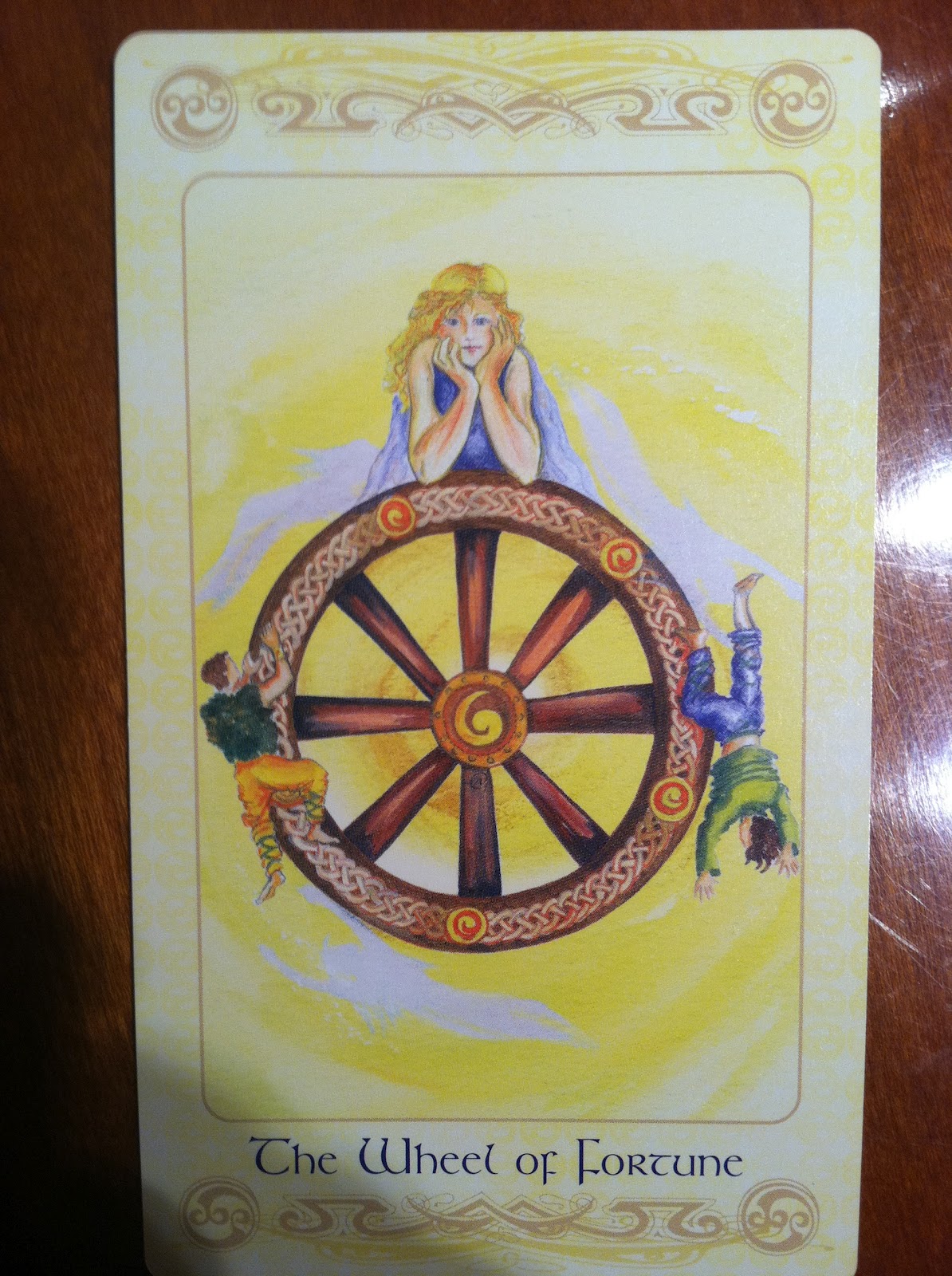
The Celtic Deck's Wheel of Fortune also shows two men, one rising and one falling. Looking closely at the man going up, one can see that he is climbing. This could mean that the questioner must strive and work to achieve his desired fate, and that it is in the questioner's power to create his destiny.
Keep in mind that I am only writing what I am seeing in this card on this particular day. When you look at the card, you may be focusing on something else. Or, you may be focusing on the man on the upswing, and seeing something totally different. That's wonderful!

An interesting aspect of Barbara G. Walker's Wheel is that it could be seen as rotating counter-clockwise, as the figure on the left with the head of an ass is falling down, while the figure on the right with the head of a hawk is climbing up. While a clockwise movement is associated with the Sun, masculinity, and the bringing in of energy in Wiccan tradition, counterclockwise is the feminine and repelling.
Barbara G. Walker writes that the figure with the Hawk head is Horus, the ancient Egyptian god of the Sun, and the plummeting man with the Ass head is Set, who represents darkness and the sterile desert (Barbara Walker Tarot 10). Using the cards and your own intuition, you can decide whether the questioner is Horus or Set in the situation, and whether it is the right time to make a move and achieve an end, or to wait and avoid disaster, or to expect delays or obstacles.
At the top is Justice, reminding us that our actions always have an effect, whether now or in the future. She keeps track of our karmic debts, and makes sure we are rewarded through the Ankh, representing love and protection, or punished through her sword.
The mention of karma leads me through association to the concept of samsara, which is the great cosmic wheel of life. In Hinduism, being in samsara means that the soul is still going through the process of reincarnation, and therefore has not reached the enlightenment necessary to enter Bhraman, or the Great Cosmic Spirit. If The Wheel of Fortune comes up in a reading, it may mean that the questioner is reaching an epiphany, or that the questioner is not quite ready for an undertaking.

Sunday, August 19, 2012
The Emperor
The Emperor is the animus to the Empress' anima. He is the Father to the Mother. He is masculine energy, majesty, and authority.

Barbara G. Walker's Emperor, shown above, is a confident man with a long beard, which is a sign of masculine maturity, tights not withstanding. The fact that the beard is black shows he is in the prime of his virility. His eagle-blazened shield symbolizes his honor and nobility. His orb and scepter illustrate his kingship. The mountains and broad sky behind him show the reach of his power and possibility.

Robin Wood's Emperor also has the full beard of maturity and virility, but it is shot with gray to temper that virility with wisdom. It is also gold, like a lion's mane, to show his regality. He is crowned with the laurel leaves of a philosopher king, and clothed in the red of fire-y power and the purple of royalty. He's got the whole world at his feet, and his arm rests have ram's heads, a symbol of sexuality and power. His codpiece also has a ram's head ;).
His animals are also important symbols. His head is flanked by two birds. I see these birds as ravens, and they remind me of Odin's ravens, Huginn and Muninn. Huginn means "thought" and Muninn means "memory." They are Odin's loyal servants, who keep him informed. Thus, the Emperor in a spread may indicate that the questioner must know who their friends are, and whom they can trust to be honest and true. It also may be telling the questioner that they have intuitive powers and shamanic prowess. This is underscored by his silver-y armor. This isn't just brawn; it's brains too. A real man embraces the Feminine. Sometimes, the Emperor may want to remind a powerful questioner of that fact.
Sometimes, the Emperor reminds me of Odin in his sacrificial aspect. One important thing about Odin is that he gave himself over to great pain to obtain knowledge of the Runes and give it to the people. Sometimes, the Emperor is there to tell us that the ultimate manly act is to sacrifice oneself--either to gain knowledge, or, even better, to help others.

Mary Guinan's illustration for Julian De Burgh's Celtic Deck shows the Emperor in a state of meditation, even melancholy. Did he see something in his orb that has brought him to this state? Or is he simply weary? What has him so worried?
Or, is he thinking of a solution to a problem?
Has he forgotten that, as The Emperor, he has the power to solve the problem, and the wisdom to find a solution? Is this what the card is trying to tell the questioner?

While I mentioned that The Emperor may remind the questioner that real masculine power must also have elements of tenderness, The Emperor may also want the questioner to embrace power, action, and force, no matter what gender. Kris Waldherr, creator of The Goddess Deck, chose Freyja, the Norse goddess of beauty and love. Freyja, a member of the peaceful Vasir, was given in marriage to broker peace between the Vasir and the war-loving Aesir. She balances action and rest, strength and gentleness. Waldherr writes, in her companion book for the deck, "Freyja becomes the link between the old world--before iron tools--and the new, where power was often expressed in violence instead of through diplomacy and tolerance. She shows that true power lies in the ability to discriminate between aggression and passivity--and the ability to choose between them at the correct time" (Waldherr 26).
Power comes from balance between opposites.
If the Emperor does not represent the questioner, he (or she, in Freyja's case) may represent someone in the questioner's life, usually a figure in power, typically a father figure, or another male presence in the questioner's life, or a woman with traditionally "masculine" attributes. This person is a good leader, someone who is kind and powerful.
Reversed, The Emperor may indicate someone who is either too weak, and is being used as a doormat, or someone who is aggressive and bullying. It may also indicate a person who is simply incompetent, especially in a leadership position. Knowing the situation will help you figure it out.
This post is dedicated, with love, to Jim Carmody--1922-2012.

Barbara G. Walker's Emperor, shown above, is a confident man with a long beard, which is a sign of masculine maturity, tights not withstanding. The fact that the beard is black shows he is in the prime of his virility. His eagle-blazened shield symbolizes his honor and nobility. His orb and scepter illustrate his kingship. The mountains and broad sky behind him show the reach of his power and possibility.

Robin Wood's Emperor also has the full beard of maturity and virility, but it is shot with gray to temper that virility with wisdom. It is also gold, like a lion's mane, to show his regality. He is crowned with the laurel leaves of a philosopher king, and clothed in the red of fire-y power and the purple of royalty. He's got the whole world at his feet, and his arm rests have ram's heads, a symbol of sexuality and power. His codpiece also has a ram's head ;).
His animals are also important symbols. His head is flanked by two birds. I see these birds as ravens, and they remind me of Odin's ravens, Huginn and Muninn. Huginn means "thought" and Muninn means "memory." They are Odin's loyal servants, who keep him informed. Thus, the Emperor in a spread may indicate that the questioner must know who their friends are, and whom they can trust to be honest and true. It also may be telling the questioner that they have intuitive powers and shamanic prowess. This is underscored by his silver-y armor. This isn't just brawn; it's brains too. A real man embraces the Feminine. Sometimes, the Emperor may want to remind a powerful questioner of that fact.
Sometimes, the Emperor reminds me of Odin in his sacrificial aspect. One important thing about Odin is that he gave himself over to great pain to obtain knowledge of the Runes and give it to the people. Sometimes, the Emperor is there to tell us that the ultimate manly act is to sacrifice oneself--either to gain knowledge, or, even better, to help others.

Mary Guinan's illustration for Julian De Burgh's Celtic Deck shows the Emperor in a state of meditation, even melancholy. Did he see something in his orb that has brought him to this state? Or is he simply weary? What has him so worried?
Or, is he thinking of a solution to a problem?
Has he forgotten that, as The Emperor, he has the power to solve the problem, and the wisdom to find a solution? Is this what the card is trying to tell the questioner?

While I mentioned that The Emperor may remind the questioner that real masculine power must also have elements of tenderness, The Emperor may also want the questioner to embrace power, action, and force, no matter what gender. Kris Waldherr, creator of The Goddess Deck, chose Freyja, the Norse goddess of beauty and love. Freyja, a member of the peaceful Vasir, was given in marriage to broker peace between the Vasir and the war-loving Aesir. She balances action and rest, strength and gentleness. Waldherr writes, in her companion book for the deck, "Freyja becomes the link between the old world--before iron tools--and the new, where power was often expressed in violence instead of through diplomacy and tolerance. She shows that true power lies in the ability to discriminate between aggression and passivity--and the ability to choose between them at the correct time" (Waldherr 26).
Power comes from balance between opposites.
If the Emperor does not represent the questioner, he (or she, in Freyja's case) may represent someone in the questioner's life, usually a figure in power, typically a father figure, or another male presence in the questioner's life, or a woman with traditionally "masculine" attributes. This person is a good leader, someone who is kind and powerful.
Reversed, The Emperor may indicate someone who is either too weak, and is being used as a doormat, or someone who is aggressive and bullying. It may also indicate a person who is simply incompetent, especially in a leadership position. Knowing the situation will help you figure it out.
This post is dedicated, with love, to Jim Carmody--1922-2012.
Saturday, August 11, 2012
The Lion with a Sun for a Mane
Leo energy is associated with the lion, which is very apropos. Leos are loyal, royal, and confident. This energy is proud and bright, just like the sun that rules the sign. Leo energy can be happy, whimsical, and childlike (the sign traditionally rules children), like a marmalade- colored kitten, or noble and majestic, like the lion.
Leo is the sign of the Performer, of those who shine out from the crowd with personalities larger than life. This energy instills a self-esteem that makes the bearer feel like a typical house cat, preening and luxurious. After all, the sun is the center of the solar system, and that is where Leo feels most comfortable. The sun is the spring board of creation, of life on this planet. Leos are the lives of the party, the stars of the show, flamboyant and exuberant. If out of balance, they are demanding and pouty, and throw colossal temper tantrums, just like Ishtar, the Babylonian goddess of love and war. Ishtar was so angry that the hero Gilgamesh turned down her sexual favors that she had a wild bull sent to kill him. When Gilgamesh's companion, Enkidu, slays the bull and tosses the bloody hide into Ishtar's temple, she kills Enkidu (MythAstrology 152-153). The pride of this placement, and of those who have this energy, is not to be trifled with.
As the Performer, Leo brings joy to people by changing himself to fit his audience. His creativity is expressed by making people laugh, and by creating characters and scenarios. He is born for the stage, for the arts, for the microphone. If Leo energy does not call its owner to act, it will push him to express his exuberance in some other way that enables him to interact with people. This can be as simple as being known for his friendliness and openness.
Balanced Leo energy loves an audience, but unbalanced Leo energy cannot live without one. The unbalanced Leo energy causes its bearer to keep a mask on continuously, a mask that attempts to portray its wearer as perfect. Underneath the cultured regality, and/or the perpetually sunny exterior, there may lurk a deep insecurity (MythAstrology 22). The person may actually adopt Leo energy as a defense against these feelings of inferiority. This insecurity, instead of being handled in a healthy way, is a catalyst for an intense need to be the center of attention and narcissism.
When out of balance, the warmth of the Leo energy can be too encompassing. It can engulf and burn. It can turn into rage--not the berserker rage of an Aries, but the sly, "catty" anger that can sneak up on its victim and slice him to ribbons. It becomes a sense of entitlement, born from that hidden sense of insecurity.
On the other hand, when out of balance, the Leo energy can become cold. Laughter fades, and creativity becomes fallow. Curiosity vanishes. The flip side of the Sun is, as we all know, the Shadow. Leo sadness is as cold and dark as Leo happiness is warm and bright.
Leo energy, when it comes to love, is pure and childlike. Since Leo is aligned with fire, the energy is passionate and active. Arien energy, also aligned with fire, is physical, competitive, courageous, and adventurous. Sagittarius, also a fire energy, is philosophical, itinerant, blunt, and independent. Leo is glamourous, cultured, urbane, and charming.
A person with balanced Leo energy is friendly and inclusive, like the sun itself. Its energy puts a spring or a slink in a step. It seems to radiate from the person. Leos are full of curiosity and amusement. The Leo, in allowing herself to be vulnerable, finds that her insecurity goes down. In being open about her love for others, she will find that this wonderful Leo energy will grow and shine effortlessly, and she will find herself in her natural habitat--the spotlight.
Archetypes, People, and Animals associated with Leo:
Cats (especially Lions)
Actors, Comedians, Dramatists, and other Performers
The Diva
Sun gods and goddesses, especially Apollo, god of the Sun and Performance
Cybele--an Anatolian Mother Goddess who became the Greek "Mistress of Animals", a Goddess whose worship included wild music, dancing, and performance
Ishtar
Colette--the 1920s French author and actress. Though she is an Aquarius (and has that archetype and energy) she is also very strongly a Leo.
How to bring in Leo energy:
1) Visualize yourself surrounded by the light of the sun. Imagine this sunlight pooling into your body, pouring into the top of your head (your crown chakra) and traveling down your spine into your heart. Feel your heart pump that warm brightness through your body. Let it relax your muscles. Feel your face muscles relax as you smile. Stretch like a cat.
2) Take a step toward being in the spotlight--tell a joke to a group of trusted friends. Tell a story about an adventure you had. If you ever had a craving to act, write, or make art, take a class.
3) If you are used to being in the spotlight, the next time you are with a group, encourage someone else to speak, and really listen.
4) Think about your favorite things to do as a child--fly a kite, run through the sprinkler, water color, put on shows. Do one of those things soon. Note how you feel afterward. Leo is the energy of children, and it will bring sunny joy into your life if you return to your roots.
5) Put on sunscreen and walk outside on a sunny day.
6) Meditate on your favorite animal. What qualities of the animal would you like to assimilate into your own personality? Carry a small charm or picture of the animal as your totem. Leo is a strong animal energy--very pure and noble, like the energy of children. Think of the lion's strength, the cat's contentment, the grace of the deer. How can you adopt these qualities?
By the way, MythAstrology is pretty much amazing and you should buy it.
Leo is the sign of the Performer, of those who shine out from the crowd with personalities larger than life. This energy instills a self-esteem that makes the bearer feel like a typical house cat, preening and luxurious. After all, the sun is the center of the solar system, and that is where Leo feels most comfortable. The sun is the spring board of creation, of life on this planet. Leos are the lives of the party, the stars of the show, flamboyant and exuberant. If out of balance, they are demanding and pouty, and throw colossal temper tantrums, just like Ishtar, the Babylonian goddess of love and war. Ishtar was so angry that the hero Gilgamesh turned down her sexual favors that she had a wild bull sent to kill him. When Gilgamesh's companion, Enkidu, slays the bull and tosses the bloody hide into Ishtar's temple, she kills Enkidu (MythAstrology 152-153). The pride of this placement, and of those who have this energy, is not to be trifled with.
As the Performer, Leo brings joy to people by changing himself to fit his audience. His creativity is expressed by making people laugh, and by creating characters and scenarios. He is born for the stage, for the arts, for the microphone. If Leo energy does not call its owner to act, it will push him to express his exuberance in some other way that enables him to interact with people. This can be as simple as being known for his friendliness and openness.
Balanced Leo energy loves an audience, but unbalanced Leo energy cannot live without one. The unbalanced Leo energy causes its bearer to keep a mask on continuously, a mask that attempts to portray its wearer as perfect. Underneath the cultured regality, and/or the perpetually sunny exterior, there may lurk a deep insecurity (MythAstrology 22). The person may actually adopt Leo energy as a defense against these feelings of inferiority. This insecurity, instead of being handled in a healthy way, is a catalyst for an intense need to be the center of attention and narcissism.
When out of balance, the warmth of the Leo energy can be too encompassing. It can engulf and burn. It can turn into rage--not the berserker rage of an Aries, but the sly, "catty" anger that can sneak up on its victim and slice him to ribbons. It becomes a sense of entitlement, born from that hidden sense of insecurity.
On the other hand, when out of balance, the Leo energy can become cold. Laughter fades, and creativity becomes fallow. Curiosity vanishes. The flip side of the Sun is, as we all know, the Shadow. Leo sadness is as cold and dark as Leo happiness is warm and bright.
Leo energy, when it comes to love, is pure and childlike. Since Leo is aligned with fire, the energy is passionate and active. Arien energy, also aligned with fire, is physical, competitive, courageous, and adventurous. Sagittarius, also a fire energy, is philosophical, itinerant, blunt, and independent. Leo is glamourous, cultured, urbane, and charming.
A person with balanced Leo energy is friendly and inclusive, like the sun itself. Its energy puts a spring or a slink in a step. It seems to radiate from the person. Leos are full of curiosity and amusement. The Leo, in allowing herself to be vulnerable, finds that her insecurity goes down. In being open about her love for others, she will find that this wonderful Leo energy will grow and shine effortlessly, and she will find herself in her natural habitat--the spotlight.
Archetypes, People, and Animals associated with Leo:
Cats (especially Lions)
Actors, Comedians, Dramatists, and other Performers
The Diva
Sun gods and goddesses, especially Apollo, god of the Sun and Performance
Cybele--an Anatolian Mother Goddess who became the Greek "Mistress of Animals", a Goddess whose worship included wild music, dancing, and performance
Ishtar
Colette--the 1920s French author and actress. Though she is an Aquarius (and has that archetype and energy) she is also very strongly a Leo.
How to bring in Leo energy:
1) Visualize yourself surrounded by the light of the sun. Imagine this sunlight pooling into your body, pouring into the top of your head (your crown chakra) and traveling down your spine into your heart. Feel your heart pump that warm brightness through your body. Let it relax your muscles. Feel your face muscles relax as you smile. Stretch like a cat.
2) Take a step toward being in the spotlight--tell a joke to a group of trusted friends. Tell a story about an adventure you had. If you ever had a craving to act, write, or make art, take a class.
3) If you are used to being in the spotlight, the next time you are with a group, encourage someone else to speak, and really listen.
4) Think about your favorite things to do as a child--fly a kite, run through the sprinkler, water color, put on shows. Do one of those things soon. Note how you feel afterward. Leo is the energy of children, and it will bring sunny joy into your life if you return to your roots.
5) Put on sunscreen and walk outside on a sunny day.
6) Meditate on your favorite animal. What qualities of the animal would you like to assimilate into your own personality? Carry a small charm or picture of the animal as your totem. Leo is a strong animal energy--very pure and noble, like the energy of children. Think of the lion's strength, the cat's contentment, the grace of the deer. How can you adopt these qualities?
By the way, MythAstrology is pretty much amazing and you should buy it.
Saturday, July 14, 2012
The High Priestess
In review:
In the beginning was The Fool, the beginner's mind, new experiences, birth and rebirth.
 Tara, the Tibetan goddess of compassion and protection, symbolizes New Beginnings in Kris Waldherr's Goddess Deck. If she appears, she will keep the questioner safe from harm as they begin their new adventure. In fact, Tara translates to "She who causes one to cross." So, the first step of the Tarot Major Arcana journey is one of getting the courage and security to set out on your adventure.
Next is gaining mastery over the self and the environment, represented by the Magician:

And now, after there is self-control and external power, the adventurer becomes introspective, and looks to the abstract.
 And we have moved from the Magician to the High Priestess. While the Magician is about skills, the High Priestess is about knowledge, especially knowledge of the Self, and knowledge of the Spirit. Kris Waldherr chose Sarasvati for the High Priestess of the Goddess Deck, and called the card itself Wisdom. Sarasvati is the Hindu goddess of wisdom, music, education, spiritual knowledge, and the arts. She floats on a lotus, a flower that symbolizes resilience. The lotus can grow out of the murkiest depths, and knowledge and enlightenment can occur in the most unlikely places.
Kris Waldherr added many wonderful details to her illustration. Look closely at Sarasvati's arms, of which she has four. This shows the reach of wisdom; enlightenment can be found in all four corners of the earth. Also, to connect her to the Magician, I would say that the four arms can symbolize the four elements, of which the High Priestess would also have mastery. The four limbs can be spiritual, mental, physical, and emotional well being and balance, as well. The book is education and commitment to learning. The beads represent spiritual commitment and ritual, and the lute she strums symbolizes music, the marriage of both the left and right brain, showing both emotional and logical balance.
 The Celtic Deck's High Priestess is shown standing in front of the moon, a symbol of feminine intuition, wisdom, and the subconscious. The moon is full to show the fertility of her imagination. Her robes are those of a priestess, someone who has been initiated onto the path. The inside of her robes is dark blue, the color of the night and the subconscious. Her sash is gold, the color of solar or male energy, showing her ability to translate this knowledge from subconscious to conscious, abstract to concrete. She stands on a verdant green lawn, vines climbing up the bricks. This is a place of mystery. If the High Priestess comes into a spread, secrets may be revealed.
Since The High Priestess is shown outdoors, she shows an understanding and a closeness to nature, a potent source of wisdom, and a source as beloved and valuable to the High Priestess as any book.

Robin Wood's High Priestess shows a woman wearing a robe in shades of blue and green, the colors of night and of water, both associated with the feminine, the subconscious, and dreams. She holds a book, to show her devotion to study, and a crystal ball, to show her sharp intuition. Her hair is black, in keeping with the mysterious colors of night, and is highlighted with silver, a feminine color because of its association with the moon (gold and the sun are masculine). Her necklace is, if you look closely, a pentacle. She also has mastery over the four elements. Her headband has a crescent moon, which is a symbol of rebirth and regeneration, as well as the cyclical nature of life, as the moon wanes or "dies" and then waxes, or is "reborn."
In a reading, the season depicted in the card may seem to be autumn/early winter, or early spring. The beauty of the Robin Wood deck is the careful detailing. One detail may stick out to you out of all the others on the card. What does this detail tell you? What does it mean to you? Why does it stick out?
 Barbara G. Walker's Papess is also full of exquisite detail. What stands out to me, right now, are the Alpha and Omega symbols on the pillars behind the Papess. Her knowledge is the beginning, the end, and everything in between. She studies the book in her lap, calm and alert, flanked by the ivory towers of accomplishment. These ivory towers may mean something else to you. On the ground in front of the Papess are two keys, which allow insights, foresights, and treasures of the subconscious to be yielded to the questioner.
At first glance, the Papess may appear to be wearing a Devo hat. This is actually meant to represent a beehive, and at the top is a crescent moon, the symbol of cycles and regeneration. The High Priestess/Papess, because of her wisdom, understands and accepts the cycles of life. The beehive is symbolic of devotion, for she is as intent on gathering wisdom as the bees are at gathering nectar. Just as bees instinctively go to the best flowers, she uses her intuition to guide her. She is wearing purple, the color of royalty, and the other dominant colors of the card are red and white--red is commonly associated with passion, and white with purity. What do these colors mean to you?
If the questioner receives this card, it could represent aspects of the questioner. The questioner may be going through a period where they feel passionate about learning. They may be having very intense, even prophetic dreams. They may be feeling very close to nature, or may have had a transcendent experience in a sacred place.
The High Priestess/Papess may also represent someone in the questioner's life. This person may be very encouraging, intuitive, and/or intelligent. This may be a female teacher, therapist, or mentor, especially in a spiritual capacity, a mother in an initiator role, or a friend who gives good advice.
The archetype of a High Priestess, which can also be found in a male, is that of an intuitive, wise, spiritual woman, a woman who perhaps is close to nature. She may be mysterious, but nurturing.
In its reversed aspect, the High Priestess could indicate a stinginess with wisdom--the questioner or a person in the questioner's life is choosing not to help a someone seeking answers. It can also indicate someone who thinks he or she is wise but is actually not experienced enough to give accurate counsel. It can also mean an estrangement from one's own intuition or subconscious, or a refusal to follow one's gut feelings. The High Priestess in reverse can also show that the questioner, or someone close, is having a full-blown spiritual crisis.
In the beginning was The Fool, the beginner's mind, new experiences, birth and rebirth.

Next is gaining mastery over the self and the environment, represented by the Magician:

And now, after there is self-control and external power, the adventurer becomes introspective, and looks to the abstract.

Kris Waldherr added many wonderful details to her illustration. Look closely at Sarasvati's arms, of which she has four. This shows the reach of wisdom; enlightenment can be found in all four corners of the earth. Also, to connect her to the Magician, I would say that the four arms can symbolize the four elements, of which the High Priestess would also have mastery. The four limbs can be spiritual, mental, physical, and emotional well being and balance, as well. The book is education and commitment to learning. The beads represent spiritual commitment and ritual, and the lute she strums symbolizes music, the marriage of both the left and right brain, showing both emotional and logical balance.
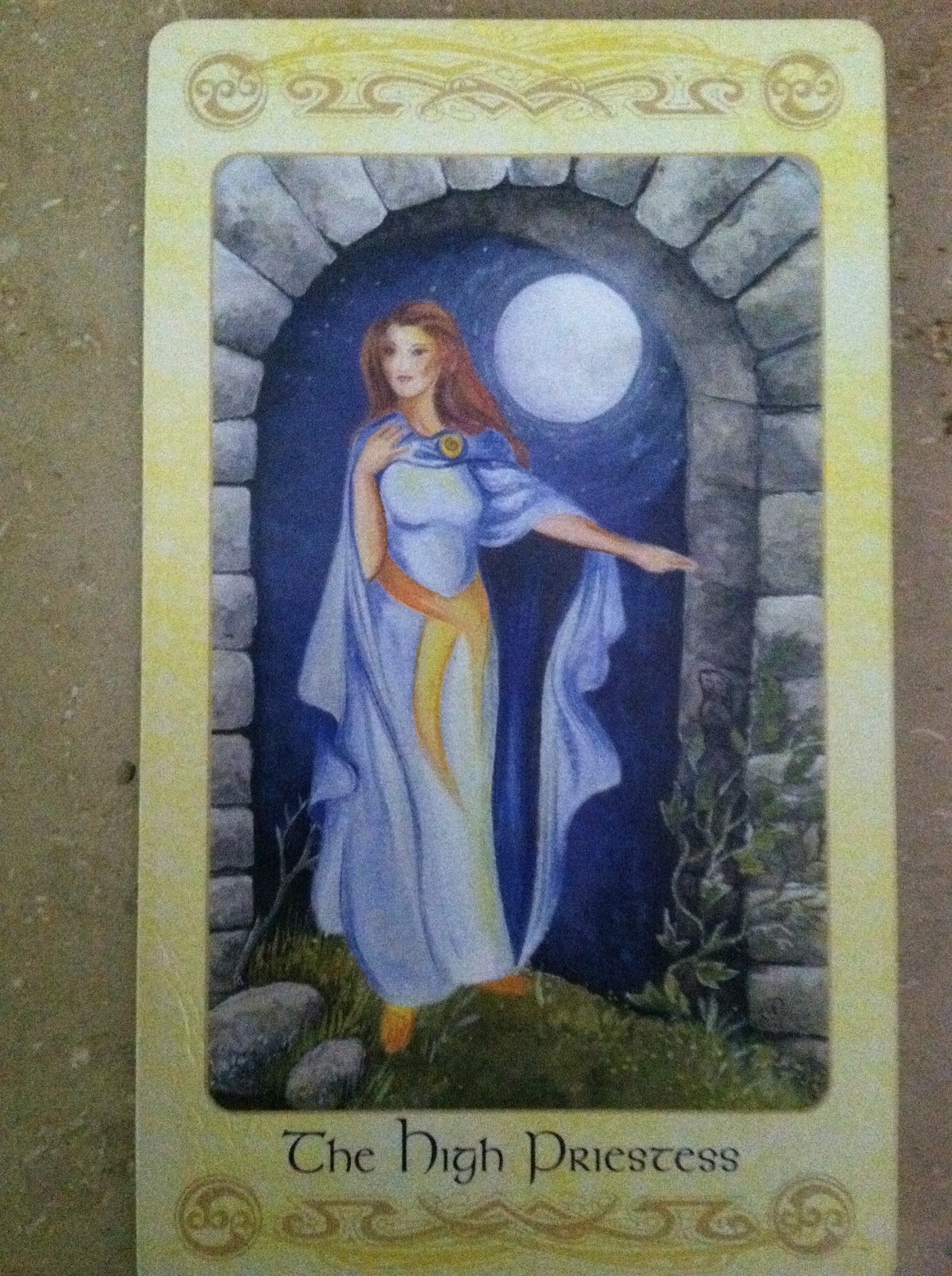
Since The High Priestess is shown outdoors, she shows an understanding and a closeness to nature, a potent source of wisdom, and a source as beloved and valuable to the High Priestess as any book.

Robin Wood's High Priestess shows a woman wearing a robe in shades of blue and green, the colors of night and of water, both associated with the feminine, the subconscious, and dreams. She holds a book, to show her devotion to study, and a crystal ball, to show her sharp intuition. Her hair is black, in keeping with the mysterious colors of night, and is highlighted with silver, a feminine color because of its association with the moon (gold and the sun are masculine). Her necklace is, if you look closely, a pentacle. She also has mastery over the four elements. Her headband has a crescent moon, which is a symbol of rebirth and regeneration, as well as the cyclical nature of life, as the moon wanes or "dies" and then waxes, or is "reborn."
In a reading, the season depicted in the card may seem to be autumn/early winter, or early spring. The beauty of the Robin Wood deck is the careful detailing. One detail may stick out to you out of all the others on the card. What does this detail tell you? What does it mean to you? Why does it stick out?

At first glance, the Papess may appear to be wearing a Devo hat. This is actually meant to represent a beehive, and at the top is a crescent moon, the symbol of cycles and regeneration. The High Priestess/Papess, because of her wisdom, understands and accepts the cycles of life. The beehive is symbolic of devotion, for she is as intent on gathering wisdom as the bees are at gathering nectar. Just as bees instinctively go to the best flowers, she uses her intuition to guide her. She is wearing purple, the color of royalty, and the other dominant colors of the card are red and white--red is commonly associated with passion, and white with purity. What do these colors mean to you?
If the questioner receives this card, it could represent aspects of the questioner. The questioner may be going through a period where they feel passionate about learning. They may be having very intense, even prophetic dreams. They may be feeling very close to nature, or may have had a transcendent experience in a sacred place.
The High Priestess/Papess may also represent someone in the questioner's life. This person may be very encouraging, intuitive, and/or intelligent. This may be a female teacher, therapist, or mentor, especially in a spiritual capacity, a mother in an initiator role, or a friend who gives good advice.
The archetype of a High Priestess, which can also be found in a male, is that of an intuitive, wise, spiritual woman, a woman who perhaps is close to nature. She may be mysterious, but nurturing.
In its reversed aspect, the High Priestess could indicate a stinginess with wisdom--the questioner or a person in the questioner's life is choosing not to help a someone seeking answers. It can also indicate someone who thinks he or she is wise but is actually not experienced enough to give accurate counsel. It can also mean an estrangement from one's own intuition or subconscious, or a refusal to follow one's gut feelings. The High Priestess in reverse can also show that the questioner, or someone close, is having a full-blown spiritual crisis.
Saturday, July 7, 2012
10 of Cups
In numerology, the number ten symbolizes the end of an old cycle and the beginning of a new one. Because of this, it resonates with a very similar energy to the number one.
The suit of Cups is the suit of Water. It is associated with the feminine, and with emotions, creativity, intuition, psychic ability, caring, and relationships.
The Ten of Cups is thus associated with great joy in its upright position.
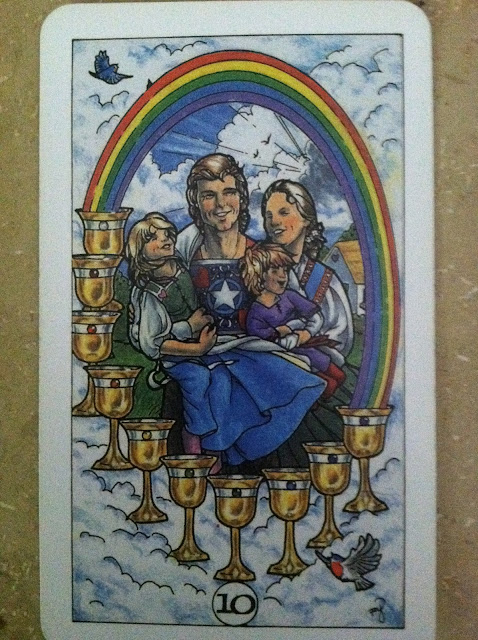
Robin Wood's Ten of Cups shows a very happy family who has seemingly found Heaven on Earth. The circle of the rainbow shows the full-circle completion represented by the Earth. In a reading, the reader may also sense that the rainbow may symbolize joy after pain.
The Ten of Cups shows a very happy family life, a very happy marriage, or the realization of a dream. If this card appears, the reader may be, or will be, in a euphoric state. It may also symbolize an awakening or a healing.

The Celtic Deck shows a young couple who look to be just starting out. They have their "Cups stacked." A life role has ended--that of being single-- and a new one is beginning. They are becoming life partners, and possibly parents. For a single person, this card may symbolize another new, happy beginning. Perhaps they may have finally found a publisher for their novel, for example.
Like the Robin Wood deck, there is a message of hope--the clouds above are clearing, and the couple may have walked "out of the woods." This may be another message of the 10 of Cups; the questioner may have emotional clarity after being muddled. They questioner may finally be stepping into the light after a dark night of the soul.

The 10 of Cups for the Goddess Deck has the rainbow making an appearance. The "full circle" is there too; look at the reflection in the water! The water is also calm and clear. There is serenity and clarity. Kris Waldherr, who chose Venus for the Cups suit, reminds us that Venus was born from water like this. A major theme of the Cups is love, after all. The moon above, like the element of water, represents the divine feminine and emotions.
 Barbara G. Walker's Ten of Cups shows a white castle, which may symbolize the goal of spiritual enlightenment, a creative endeavor, or true love. He is guided by his feminine side, his anima, or emotions. He is thinking with his gut and heart, which will lead him to his goal. The Ten of Cups may be advising that you may need to turn off the logical, reasonable part of the brain, which may be keeping you hemming and hawing, and instead listen to your emotions. When you think about a certain course of action, how do you feel in your body? Do you feel lighter and relaxed, or heavy, tense, and queasy? Does the "sensible" course of action leave you feeling numb, cold, or sad? These feelings shouldn't be discounted.
Another interpretation for the Ten of Cups, as seen in the Barbara G. Walker deck, is that love can save. Salvation can be found through strong, loving relationships with others. Unconditional love is especially potent as an agent of healing, whether this healing is physical, emotional, mental, or spiritual.
The Ten of Cups reversed may indicate dissatisfaction. The questioner may be blind to the good things in her life. The Ten of Cups may also indicate discord or disharmony, or a lack of love. There may be fighting, or the thrill may have gone out of a relationship. There may be problems between parents and children. Other cards will help the reader figure out what is happening.
The suit of Cups is the suit of Water. It is associated with the feminine, and with emotions, creativity, intuition, psychic ability, caring, and relationships.
The Ten of Cups is thus associated with great joy in its upright position.
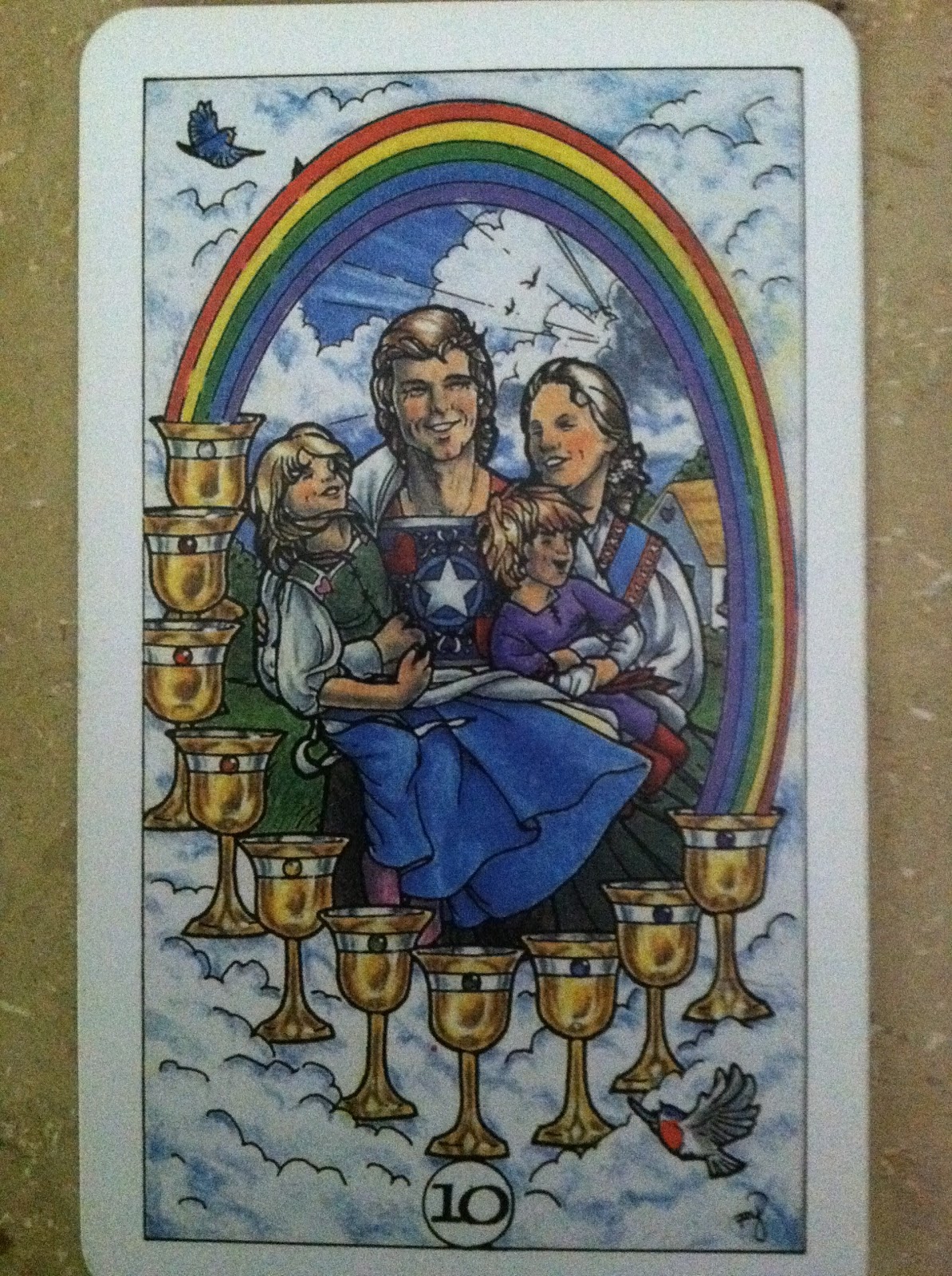
Robin Wood's Ten of Cups shows a very happy family who has seemingly found Heaven on Earth. The circle of the rainbow shows the full-circle completion represented by the Earth. In a reading, the reader may also sense that the rainbow may symbolize joy after pain.
The Ten of Cups shows a very happy family life, a very happy marriage, or the realization of a dream. If this card appears, the reader may be, or will be, in a euphoric state. It may also symbolize an awakening or a healing.

The Celtic Deck shows a young couple who look to be just starting out. They have their "Cups stacked." A life role has ended--that of being single-- and a new one is beginning. They are becoming life partners, and possibly parents. For a single person, this card may symbolize another new, happy beginning. Perhaps they may have finally found a publisher for their novel, for example.
Like the Robin Wood deck, there is a message of hope--the clouds above are clearing, and the couple may have walked "out of the woods." This may be another message of the 10 of Cups; the questioner may have emotional clarity after being muddled. They questioner may finally be stepping into the light after a dark night of the soul.

The 10 of Cups for the Goddess Deck has the rainbow making an appearance. The "full circle" is there too; look at the reflection in the water! The water is also calm and clear. There is serenity and clarity. Kris Waldherr, who chose Venus for the Cups suit, reminds us that Venus was born from water like this. A major theme of the Cups is love, after all. The moon above, like the element of water, represents the divine feminine and emotions.

Another interpretation for the Ten of Cups, as seen in the Barbara G. Walker deck, is that love can save. Salvation can be found through strong, loving relationships with others. Unconditional love is especially potent as an agent of healing, whether this healing is physical, emotional, mental, or spiritual.
The Ten of Cups reversed may indicate dissatisfaction. The questioner may be blind to the good things in her life. The Ten of Cups may also indicate discord or disharmony, or a lack of love. There may be fighting, or the thrill may have gone out of a relationship. There may be problems between parents and children. Other cards will help the reader figure out what is happening.
Subscribe to:
Posts (Atom)