Leo energy is associated with the lion, which is very apropos. Leos are loyal, royal, and confident. This energy is proud and bright, just like the sun that rules the sign. Leo energy can be happy, whimsical, and childlike (the sign traditionally rules children), like a marmalade- colored kitten, or noble and majestic, like the lion.
Leo is the sign of the Performer, of those who shine out from the crowd with personalities larger than life. This energy instills a self-esteem that makes the bearer feel like a typical house cat, preening and luxurious. After all, the sun is the center of the solar system, and that is where Leo feels most comfortable. The sun is the spring board of creation, of life on this planet. Leos are the lives of the party, the stars of the show, flamboyant and exuberant. If out of balance, they are demanding and pouty, and throw colossal temper tantrums, just like Ishtar, the Babylonian goddess of love and war. Ishtar was so angry that the hero Gilgamesh turned down her sexual favors that she had a wild bull sent to kill him. When Gilgamesh's companion, Enkidu, slays the bull and tosses the bloody hide into Ishtar's temple, she kills Enkidu (MythAstrology 152-153). The pride of this placement, and of those who have this energy, is not to be trifled with.
As the Performer, Leo brings joy to people by changing himself to fit his audience. His creativity is expressed by making people laugh, and by creating characters and scenarios. He is born for the stage, for the arts, for the microphone. If Leo energy does not call its owner to act, it will push him to express his exuberance in some other way that enables him to interact with people. This can be as simple as being known for his friendliness and openness.
Balanced Leo energy loves an audience, but unbalanced Leo energy cannot live without one. The unbalanced Leo energy causes its bearer to keep a mask on continuously, a mask that attempts to portray its wearer as perfect. Underneath the cultured regality, and/or the perpetually sunny exterior, there may lurk a deep insecurity (MythAstrology 22). The person may actually adopt Leo energy as a defense against these feelings of inferiority. This insecurity, instead of being handled in a healthy way, is a catalyst for an intense need to be the center of attention and narcissism.
When out of balance, the warmth of the Leo energy can be too encompassing. It can engulf and burn. It can turn into rage--not the berserker rage of an Aries, but the sly, "catty" anger that can sneak up on its victim and slice him to ribbons. It becomes a sense of entitlement, born from that hidden sense of insecurity.
On the other hand, when out of balance, the Leo energy can become cold. Laughter fades, and creativity becomes fallow. Curiosity vanishes. The flip side of the Sun is, as we all know, the Shadow. Leo sadness is as cold and dark as Leo happiness is warm and bright.
Leo energy, when it comes to love, is pure and childlike. Since Leo is aligned with fire, the energy is passionate and active. Arien energy, also aligned with fire, is physical, competitive, courageous, and adventurous. Sagittarius, also a fire energy, is philosophical, itinerant, blunt, and independent. Leo is glamourous, cultured, urbane, and charming.
A person with balanced Leo energy is friendly and inclusive, like the sun itself. Its energy puts a spring or a slink in a step. It seems to radiate from the person. Leos are full of curiosity and amusement. The Leo, in allowing herself to be vulnerable, finds that her insecurity goes down. In being open about her love for others, she will find that this wonderful Leo energy will grow and shine effortlessly, and she will find herself in her natural habitat--the spotlight.
Archetypes, People, and Animals associated with Leo:
Cats (especially Lions)
Actors, Comedians, Dramatists, and other Performers
The Diva
Sun gods and goddesses, especially Apollo, god of the Sun and Performance
Cybele--an Anatolian Mother Goddess who became the Greek "Mistress of Animals", a Goddess whose worship included wild music, dancing, and performance
Ishtar
Colette--the 1920s French author and actress. Though she is an Aquarius (and has that archetype and energy) she is also very strongly a Leo.
How to bring in Leo energy:
1) Visualize yourself surrounded by the light of the sun. Imagine this sunlight pooling into your body, pouring into the top of your head (your crown chakra) and traveling down your spine into your heart. Feel your heart pump that warm brightness through your body. Let it relax your muscles. Feel your face muscles relax as you smile. Stretch like a cat.
2) Take a step toward being in the spotlight--tell a joke to a group of trusted friends. Tell a story about an adventure you had. If you ever had a craving to act, write, or make art, take a class.
3) If you are used to being in the spotlight, the next time you are with a group, encourage someone else to speak, and really listen.
4) Think about your favorite things to do as a child--fly a kite, run through the sprinkler, water color, put on shows. Do one of those things soon. Note how you feel afterward. Leo is the energy of children, and it will bring sunny joy into your life if you return to your roots.
5) Put on sunscreen and walk outside on a sunny day.
6) Meditate on your favorite animal. What qualities of the animal would you like to assimilate into your own personality? Carry a small charm or picture of the animal as your totem. Leo is a strong animal energy--very pure and noble, like the energy of children. Think of the lion's strength, the cat's contentment, the grace of the deer. How can you adopt these qualities?
By the way, MythAstrology is pretty much amazing and you should buy it.
Saturday, August 11, 2012

Saturday, July 14, 2012
The High Priestess
In review:
In the beginning was The Fool, the beginner's mind, new experiences, birth and rebirth.
 Tara, the Tibetan goddess of compassion and protection, symbolizes New Beginnings in Kris Waldherr's Goddess Deck. If she appears, she will keep the questioner safe from harm as they begin their new adventure. In fact, Tara translates to "She who causes one to cross." So, the first step of the Tarot Major Arcana journey is one of getting the courage and security to set out on your adventure.
Next is gaining mastery over the self and the environment, represented by the Magician:

And now, after there is self-control and external power, the adventurer becomes introspective, and looks to the abstract.
 And we have moved from the Magician to the High Priestess. While the Magician is about skills, the High Priestess is about knowledge, especially knowledge of the Self, and knowledge of the Spirit. Kris Waldherr chose Sarasvati for the High Priestess of the Goddess Deck, and called the card itself Wisdom. Sarasvati is the Hindu goddess of wisdom, music, education, spiritual knowledge, and the arts. She floats on a lotus, a flower that symbolizes resilience. The lotus can grow out of the murkiest depths, and knowledge and enlightenment can occur in the most unlikely places.
Kris Waldherr added many wonderful details to her illustration. Look closely at Sarasvati's arms, of which she has four. This shows the reach of wisdom; enlightenment can be found in all four corners of the earth. Also, to connect her to the Magician, I would say that the four arms can symbolize the four elements, of which the High Priestess would also have mastery. The four limbs can be spiritual, mental, physical, and emotional well being and balance, as well. The book is education and commitment to learning. The beads represent spiritual commitment and ritual, and the lute she strums symbolizes music, the marriage of both the left and right brain, showing both emotional and logical balance.
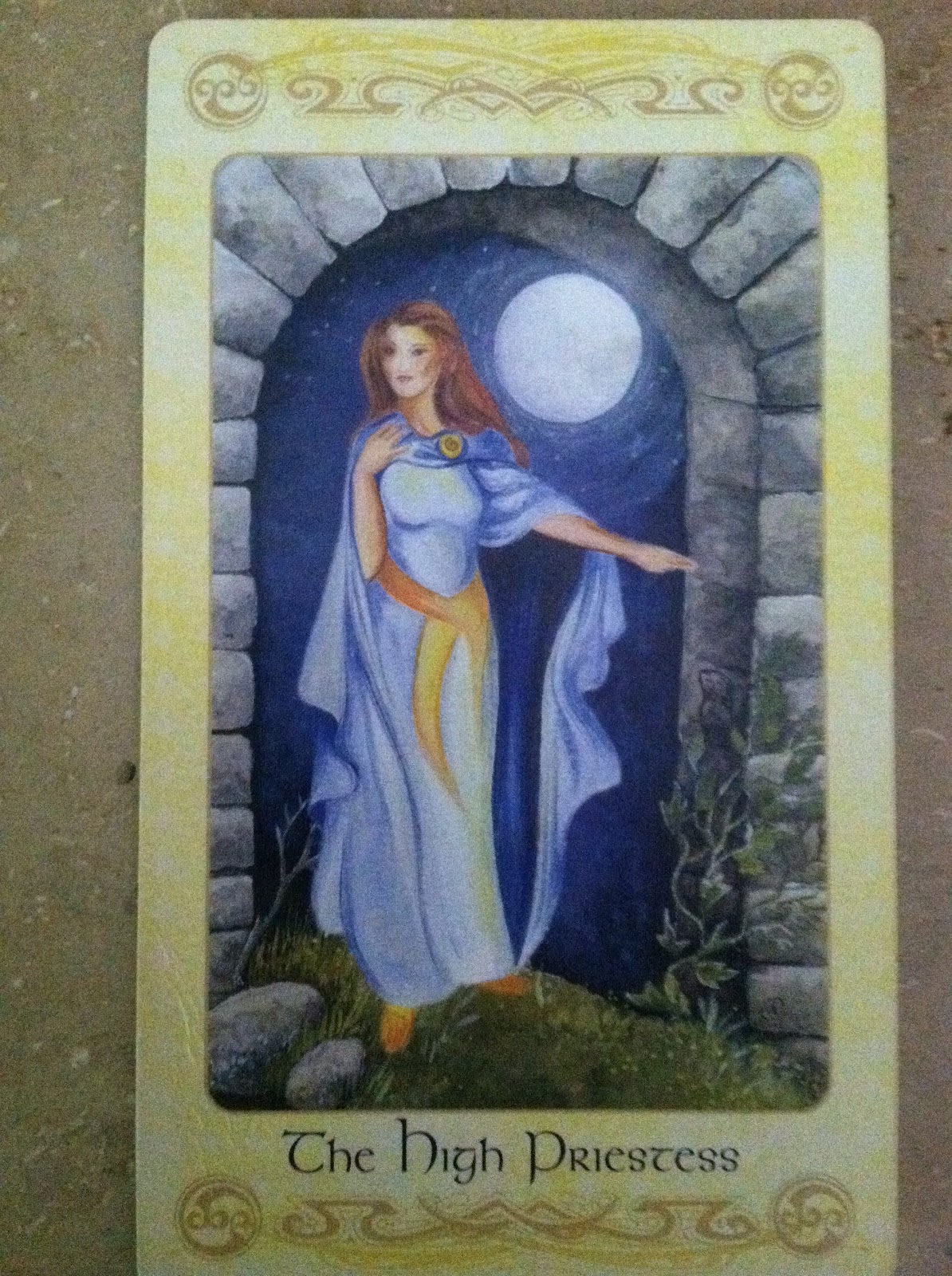
 The Celtic Deck's High Priestess is shown standing in front of the moon, a symbol of feminine intuition, wisdom, and the subconscious. The moon is full to show the fertility of her imagination. Her robes are those of a priestess, someone who has been initiated onto the path. The inside of her robes is dark blue, the color of the night and the subconscious. Her sash is gold, the color of solar or male energy, showing her ability to translate this knowledge from subconscious to conscious, abstract to concrete. She stands on a verdant green lawn, vines climbing up the bricks. This is a place of mystery. If the High Priestess comes into a spread, secrets may be revealed.
Since The High Priestess is shown outdoors, she shows an understanding and a closeness to nature, a potent source of wisdom, and a source as beloved and valuable to the High Priestess as any book.

Robin Wood's High Priestess shows a woman wearing a robe in shades of blue and green, the colors of night and of water, both associated with the feminine, the subconscious, and dreams. She holds a book, to show her devotion to study, and a crystal ball, to show her sharp intuition. Her hair is black, in keeping with the mysterious colors of night, and is highlighted with silver, a feminine color because of its association with the moon (gold and the sun are masculine). Her necklace is, if you look closely, a pentacle. She also has mastery over the four elements. Her headband has a crescent moon, which is a symbol of rebirth and regeneration, as well as the cyclical nature of life, as the moon wanes or "dies" and then waxes, or is "reborn."
In a reading, the season depicted in the card may seem to be autumn/early winter, or early spring. The beauty of the Robin Wood deck is the careful detailing. One detail may stick out to you out of all the others on the card. What does this detail tell you? What does it mean to you? Why does it stick out?
 Barbara G. Walker's Papess is also full of exquisite detail. What stands out to me, right now, are the Alpha and Omega symbols on the pillars behind the Papess. Her knowledge is the beginning, the end, and everything in between. She studies the book in her lap, calm and alert, flanked by the ivory towers of accomplishment. These ivory towers may mean something else to you. On the ground in front of the Papess are two keys, which allow insights, foresights, and treasures of the subconscious to be yielded to the questioner.
At first glance, the Papess may appear to be wearing a Devo hat. This is actually meant to represent a beehive, and at the top is a crescent moon, the symbol of cycles and regeneration. The High Priestess/Papess, because of her wisdom, understands and accepts the cycles of life. The beehive is symbolic of devotion, for she is as intent on gathering wisdom as the bees are at gathering nectar. Just as bees instinctively go to the best flowers, she uses her intuition to guide her. She is wearing purple, the color of royalty, and the other dominant colors of the card are red and white--red is commonly associated with passion, and white with purity. What do these colors mean to you?
If the questioner receives this card, it could represent aspects of the questioner. The questioner may be going through a period where they feel passionate about learning. They may be having very intense, even prophetic dreams. They may be feeling very close to nature, or may have had a transcendent experience in a sacred place.
The High Priestess/Papess may also represent someone in the questioner's life. This person may be very encouraging, intuitive, and/or intelligent. This may be a female teacher, therapist, or mentor, especially in a spiritual capacity, a mother in an initiator role, or a friend who gives good advice.
The archetype of a High Priestess, which can also be found in a male, is that of an intuitive, wise, spiritual woman, a woman who perhaps is close to nature. She may be mysterious, but nurturing.
In its reversed aspect, the High Priestess could indicate a stinginess with wisdom--the questioner or a person in the questioner's life is choosing not to help a someone seeking answers. It can also indicate someone who thinks he or she is wise but is actually not experienced enough to give accurate counsel. It can also mean an estrangement from one's own intuition or subconscious, or a refusal to follow one's gut feelings. The High Priestess in reverse can also show that the questioner, or someone close, is having a full-blown spiritual crisis.
In the beginning was The Fool, the beginner's mind, new experiences, birth and rebirth.

Next is gaining mastery over the self and the environment, represented by the Magician:

And now, after there is self-control and external power, the adventurer becomes introspective, and looks to the abstract.

Kris Waldherr added many wonderful details to her illustration. Look closely at Sarasvati's arms, of which she has four. This shows the reach of wisdom; enlightenment can be found in all four corners of the earth. Also, to connect her to the Magician, I would say that the four arms can symbolize the four elements, of which the High Priestess would also have mastery. The four limbs can be spiritual, mental, physical, and emotional well being and balance, as well. The book is education and commitment to learning. The beads represent spiritual commitment and ritual, and the lute she strums symbolizes music, the marriage of both the left and right brain, showing both emotional and logical balance.
Since The High Priestess is shown outdoors, she shows an understanding and a closeness to nature, a potent source of wisdom, and a source as beloved and valuable to the High Priestess as any book.

Robin Wood's High Priestess shows a woman wearing a robe in shades of blue and green, the colors of night and of water, both associated with the feminine, the subconscious, and dreams. She holds a book, to show her devotion to study, and a crystal ball, to show her sharp intuition. Her hair is black, in keeping with the mysterious colors of night, and is highlighted with silver, a feminine color because of its association with the moon (gold and the sun are masculine). Her necklace is, if you look closely, a pentacle. She also has mastery over the four elements. Her headband has a crescent moon, which is a symbol of rebirth and regeneration, as well as the cyclical nature of life, as the moon wanes or "dies" and then waxes, or is "reborn."
In a reading, the season depicted in the card may seem to be autumn/early winter, or early spring. The beauty of the Robin Wood deck is the careful detailing. One detail may stick out to you out of all the others on the card. What does this detail tell you? What does it mean to you? Why does it stick out?

At first glance, the Papess may appear to be wearing a Devo hat. This is actually meant to represent a beehive, and at the top is a crescent moon, the symbol of cycles and regeneration. The High Priestess/Papess, because of her wisdom, understands and accepts the cycles of life. The beehive is symbolic of devotion, for she is as intent on gathering wisdom as the bees are at gathering nectar. Just as bees instinctively go to the best flowers, she uses her intuition to guide her. She is wearing purple, the color of royalty, and the other dominant colors of the card are red and white--red is commonly associated with passion, and white with purity. What do these colors mean to you?
If the questioner receives this card, it could represent aspects of the questioner. The questioner may be going through a period where they feel passionate about learning. They may be having very intense, even prophetic dreams. They may be feeling very close to nature, or may have had a transcendent experience in a sacred place.
The High Priestess/Papess may also represent someone in the questioner's life. This person may be very encouraging, intuitive, and/or intelligent. This may be a female teacher, therapist, or mentor, especially in a spiritual capacity, a mother in an initiator role, or a friend who gives good advice.
The archetype of a High Priestess, which can also be found in a male, is that of an intuitive, wise, spiritual woman, a woman who perhaps is close to nature. She may be mysterious, but nurturing.
In its reversed aspect, the High Priestess could indicate a stinginess with wisdom--the questioner or a person in the questioner's life is choosing not to help a someone seeking answers. It can also indicate someone who thinks he or she is wise but is actually not experienced enough to give accurate counsel. It can also mean an estrangement from one's own intuition or subconscious, or a refusal to follow one's gut feelings. The High Priestess in reverse can also show that the questioner, or someone close, is having a full-blown spiritual crisis.
Saturday, July 7, 2012
10 of Cups
In numerology, the number ten symbolizes the end of an old cycle and the beginning of a new one. Because of this, it resonates with a very similar energy to the number one.
The suit of Cups is the suit of Water. It is associated with the feminine, and with emotions, creativity, intuition, psychic ability, caring, and relationships.
The Ten of Cups is thus associated with great joy in its upright position.
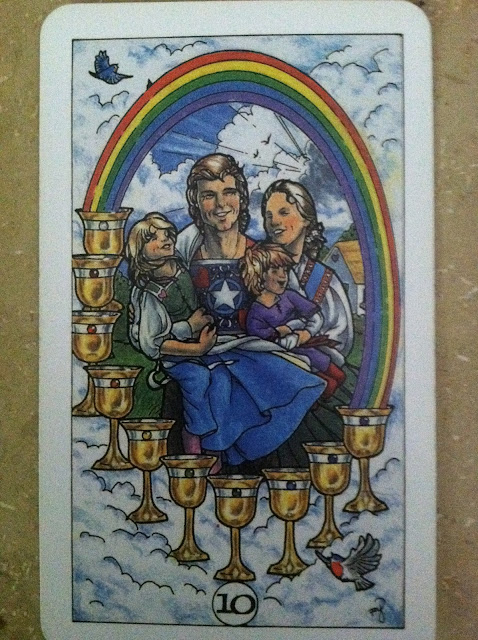
Robin Wood's Ten of Cups shows a very happy family who has seemingly found Heaven on Earth. The circle of the rainbow shows the full-circle completion represented by the Earth. In a reading, the reader may also sense that the rainbow may symbolize joy after pain.
The Ten of Cups shows a very happy family life, a very happy marriage, or the realization of a dream. If this card appears, the reader may be, or will be, in a euphoric state. It may also symbolize an awakening or a healing.

The Celtic Deck shows a young couple who look to be just starting out. They have their "Cups stacked." A life role has ended--that of being single-- and a new one is beginning. They are becoming life partners, and possibly parents. For a single person, this card may symbolize another new, happy beginning. Perhaps they may have finally found a publisher for their novel, for example.
Like the Robin Wood deck, there is a message of hope--the clouds above are clearing, and the couple may have walked "out of the woods." This may be another message of the 10 of Cups; the questioner may have emotional clarity after being muddled. They questioner may finally be stepping into the light after a dark night of the soul.

The 10 of Cups for the Goddess Deck has the rainbow making an appearance. The "full circle" is there too; look at the reflection in the water! The water is also calm and clear. There is serenity and clarity. Kris Waldherr, who chose Venus for the Cups suit, reminds us that Venus was born from water like this. A major theme of the Cups is love, after all. The moon above, like the element of water, represents the divine feminine and emotions.
 Barbara G. Walker's Ten of Cups shows a white castle, which may symbolize the goal of spiritual enlightenment, a creative endeavor, or true love. He is guided by his feminine side, his anima, or emotions. He is thinking with his gut and heart, which will lead him to his goal. The Ten of Cups may be advising that you may need to turn off the logical, reasonable part of the brain, which may be keeping you hemming and hawing, and instead listen to your emotions. When you think about a certain course of action, how do you feel in your body? Do you feel lighter and relaxed, or heavy, tense, and queasy? Does the "sensible" course of action leave you feeling numb, cold, or sad? These feelings shouldn't be discounted.
Another interpretation for the Ten of Cups, as seen in the Barbara G. Walker deck, is that love can save. Salvation can be found through strong, loving relationships with others. Unconditional love is especially potent as an agent of healing, whether this healing is physical, emotional, mental, or spiritual.
The Ten of Cups reversed may indicate dissatisfaction. The questioner may be blind to the good things in her life. The Ten of Cups may also indicate discord or disharmony, or a lack of love. There may be fighting, or the thrill may have gone out of a relationship. There may be problems between parents and children. Other cards will help the reader figure out what is happening.
The suit of Cups is the suit of Water. It is associated with the feminine, and with emotions, creativity, intuition, psychic ability, caring, and relationships.
The Ten of Cups is thus associated with great joy in its upright position.
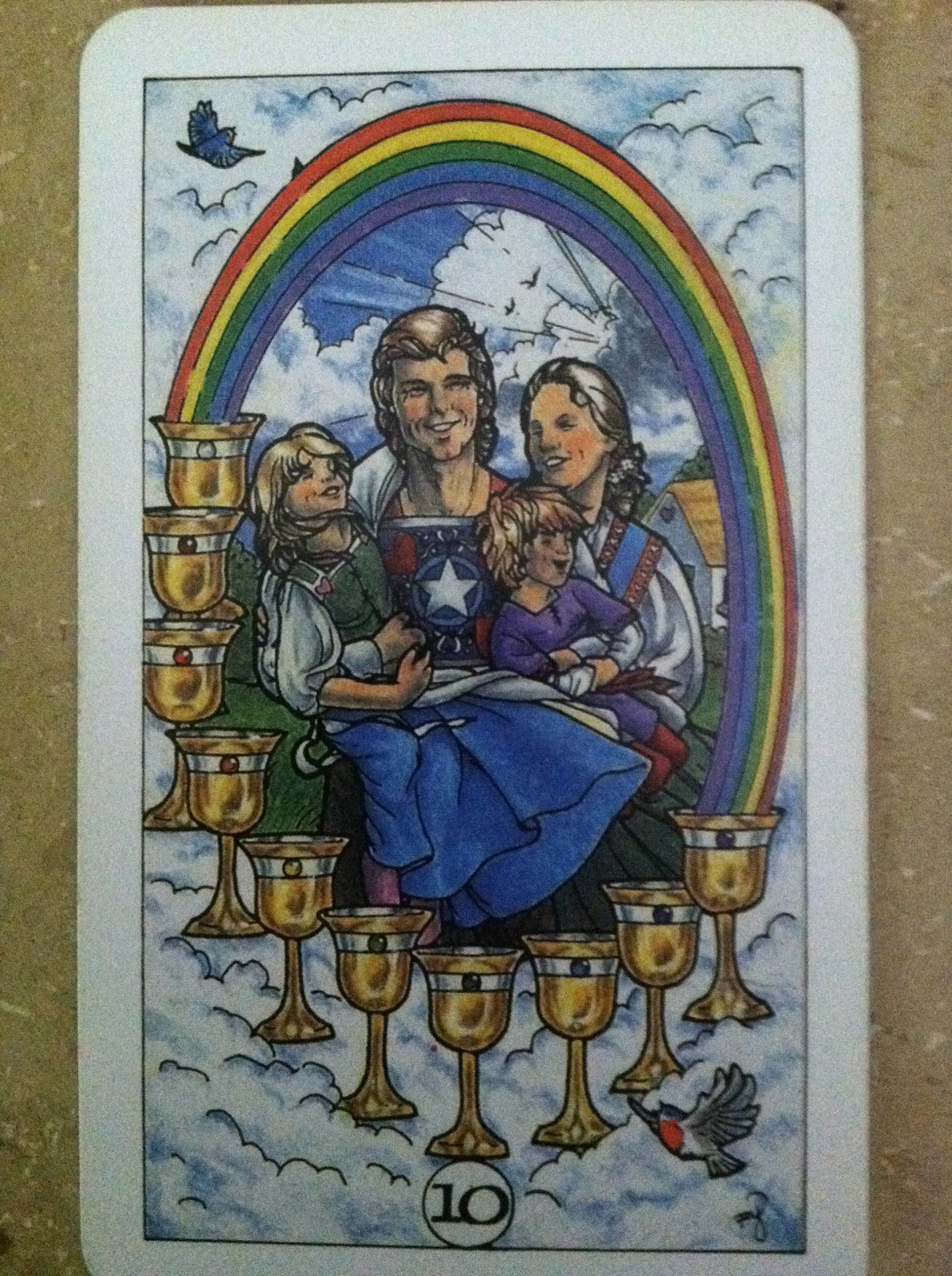
Robin Wood's Ten of Cups shows a very happy family who has seemingly found Heaven on Earth. The circle of the rainbow shows the full-circle completion represented by the Earth. In a reading, the reader may also sense that the rainbow may symbolize joy after pain.
The Ten of Cups shows a very happy family life, a very happy marriage, or the realization of a dream. If this card appears, the reader may be, or will be, in a euphoric state. It may also symbolize an awakening or a healing.

The Celtic Deck shows a young couple who look to be just starting out. They have their "Cups stacked." A life role has ended--that of being single-- and a new one is beginning. They are becoming life partners, and possibly parents. For a single person, this card may symbolize another new, happy beginning. Perhaps they may have finally found a publisher for their novel, for example.
Like the Robin Wood deck, there is a message of hope--the clouds above are clearing, and the couple may have walked "out of the woods." This may be another message of the 10 of Cups; the questioner may have emotional clarity after being muddled. They questioner may finally be stepping into the light after a dark night of the soul.

The 10 of Cups for the Goddess Deck has the rainbow making an appearance. The "full circle" is there too; look at the reflection in the water! The water is also calm and clear. There is serenity and clarity. Kris Waldherr, who chose Venus for the Cups suit, reminds us that Venus was born from water like this. A major theme of the Cups is love, after all. The moon above, like the element of water, represents the divine feminine and emotions.

Another interpretation for the Ten of Cups, as seen in the Barbara G. Walker deck, is that love can save. Salvation can be found through strong, loving relationships with others. Unconditional love is especially potent as an agent of healing, whether this healing is physical, emotional, mental, or spiritual.
The Ten of Cups reversed may indicate dissatisfaction. The questioner may be blind to the good things in her life. The Ten of Cups may also indicate discord or disharmony, or a lack of love. There may be fighting, or the thrill may have gone out of a relationship. There may be problems between parents and children. Other cards will help the reader figure out what is happening.
Tuesday, July 3, 2012
Luna
I think it's time to change Cancer's name. Please don't take this to mean I'm arrogant enough to suppose a name thousands of years old can be changed because I want it to. It's more that I personally feel uncomfortable referring to myself and my brethren as a disease. Let's face it, we don't think of the constellation; we think of the illness. I don't know about you, but that makes me feel kind of shitty.
Just for fun, what could Moon Children call themselves? Here are some ideas:
1) Selene. Selene is the goddess of the Moon in Greek mythology. This name is easy to remember, and sounds as lovely as the goddess herself.
2) Fegarri. Fegarri is the Greek word for moon. I think it sounds harmonious with Sagittarius and Virgo. The bad part is that it sounds like an alien race from Star Trek.
3) Huitaco (pronounced we-tah-co) (thanks to my awesome soul sister and colleague, Whitney. Check out her blog: wheresmytower.wordpress.com). Huitaco is the Columbian goddess of the Moon and protector of women. She was also the goddess of pleasure and happiness. The frequently tangled with her consort, Bochica, the god of hard work and sorrow. Bochica reminds me of Saturn, the planet that rules Capricorn, the sign of hard work and hard lessons. Moon Children oppose Capricorn (not OPPOSE oppose, but are opposite each other on the zodiac wheel). There's some nice synchronicity there, but the name sounds like "Wheat Taco" which is what we will forever be known as to people who don't know about the myth.
4) Luna. Italian for Moon, and the Roman parallel to Selene. Yes, it's a Harry Potter character (and a character with very Piscean energy, at that, but Leo is a DiCaprio).
I think, for this article, I will refer to this energy as Luna/Lunar. It is the name of our Moon.
I myself am a Luna, and far from perfectly balanced. I tend to focus on what is difficult about this energy. Luna is a water sign, and Lunar energy is highly emotional. I mean, EXTREMELY so. It is difficult to separate this energy from these emotions and look at things rationally and impersonally. Also, this is an intense energy. Irritation quickly becomes raging frustration. The blues and everyday disappointments can lead to sogginess from copious weeping. On the other hand, contentment becomes joy, happiness is euphoria, and love turns into rapture. We are also literally quite watery; we tend to weep a lot.
The stomach and the breasts are the organs ruled by Luna. It's fitting that the breasts would be the organ for Luna--these are the mothers of the zodiac, after all, and the stomach keeps us alive through nourishment, another forte of Lunar energy. The stomach is also full of associations of being loved and mothered with food.
Lunar energy also helps you think with your gut, and aligns you with the third chakra, the bright, sunshine yellow spot of energy located behind your navel. This spot in your body corresponds to your personal power. While Capricorn's lesson is that of mastering perfectionism, and to release the need for external validation, and Scorpio's lesson is to learn to accept the dark parts of the Self, identify the dark parts that are useful, transmute the useful and let go of what's not, and eventually rise above the dark parts as a new Self-creation, the energy of Luna is to discover power. Notoriously timid, this energy's lesson is to develop a belief in one's Self, and in the Self's worthiness.
Luna rules the stomach, just as Capricorn rules the knees (the work horses of the body) and Scorpio rules the genitals (the seat of birth and death--"Le Petit Mort"). This is the location of the third chakra. The third chakra is the seat of self-esteem, responsibility, and courage. Out of balance, this is the seat of low self-esteem and fear, especially fear of rejection and failure (Myss 167-168).
The dark side of Lunar energy is a mess of insecurity. Luna energy that is out of balance give themselves impossible standards, standards so high the person becomes frozen out of fear of failure. It is the same kind of fear that keeps people lonely, because they aren't willing to approach others. Lunas are extremely hard on themselves, and tend to say "I'm sorry" a lot.
Lunar love is intense and maternal. It is so intense, in fact, that it hurts. The goddess Raven Kaldera associates with the sun in Luna is Demeter. Demeter, the goddess of the grain, deeply loves her daughter, Persephone, and when Persephone is taken away by Hades, it sends her into a tailspin, a tailspin that takes the whole world down with it. Crops stop growing, and the earth becomes a cold wasteland. When a Luna feels hurt or abandoned, the psyche becomes a wasteland. A Luna attaches herself to a loved one, not in a creepy stalker way, but a Luna opens her heart to any one she loves, and gives freely of it. When the person they love goes away, there is a definite ripping sensation in the heart.
Perhaps this is because Luna is self-protective. When they do trust and love someone, they have to remove layers of their hard, protective shields, the "shell" of the crab. When that trust feels violated, Luna rebuilds the shell again, and reinforces it.
This metaphorical shell is also like a turtle's shell. If a Luna is in balance, he can feel at home anywhere he goes. He will be grounded and secure, and he will help others feel secure as well.
Lunas are all about the love. A Luna will give her all to her loved ones, and will feel guilty if she feels she comes up short. They are warm, comforting, and sensitive, when in balance. However, when out of balance, Luna becomes clingy and possessive. Unable to express "negative" emotions (and thus possibly anger a loved one) Luna becomes passive-aggressive and as brackish and bitter as a polluted ocean. Alternately, if the Luna is not secure enough to set boundaries, the roiling anger builds up until the dam breaks, and the Luna drowns the world in her rage.
Like the Moon, and the tides the Moon makes, Lunar emotions ebb and flow. This is very feminine; the word "month" comes from the same root as Moon, as do the words menses and menstruation. I have found that my physical energy, creativity, and motivation also ebb and flow, and I wonder if perhaps other Lunas feel like this. I actually find it rather comforting--I know that when I feel low or dry, the tide will rise and I will be nourished again. Meanwhile, I have spare energies that I can tap.
The Moon is a symbol of illusion. Lunas must be careful to see past illusion. They must be especially careful not to fall into the all-or-nothing thinking common with the shadow aspect of this energy. When they feel unloved, they must ask themselves if it is really true. They must exercise their minds to see the opposites of their negative thoughts. Can a Luna think of three people that like her? Then, the negative thought is not true. If you feel abandoned by a friend, is it true? Did this friend abandon you? Or are you abandoning yourself by letting this event change how you perceive yourself and your own innate goodness? Did this friend really abandon you? Did a friend abandon you, or just an acquaintance? Or, worse yet, someone who was using you?
Lunas are blessed with great intuition and imagination. Even an out-of-sorts Luna can intuit for her loved ones, even if she can't intuit for herself. Even if the Luna is suffering from depression or garden variety writer's block, they have a rich inner life. Sometimes, they must sit down and let the ink flow freely, like water, without any censorship. This helps them access that powerful Moon energy. Since the tummy is the provence of the Lunas, many would do nicely to just think with their "guts" and not overanalyze a decision.
It must be remembered that the energy of the signs is not just for the people born in the sign alone. You may feel you have more energy associated with one zodiac archetype than another, but you can access the archetypal energy of any sign.
Questions for Reflection, and Tips to Bring Lunar Energy in:
1) When making a decision, pay attention to how your body feels, instead of endlessly reasoning yourself through it.
2) Keep a dream journal. Lunar energy, like the other watery energies of Pisces and Scorpio, works with the subconscious.
3) When you nurture others, do you also nurture yourself?
4) What illusions do you maintain? How do they benefit you? How would your life be without these illusions? How can you let go of them?
Archetypes, People, and Animals for Luna
1) Mothers
2) Nurses
3) Family Historians/Museum Keepers
4) Demeter
5) Kwan Yin, the Chinese Goddess of Compassion
6) Turtles and Crabs
7) Wolves and Dogs,, symbols of loyalty, family, and friendship
Book recommendations:
MythAstrology: Exploring Planets and Pantheons by Raven Kaldera (You still haven't bought it yet? It's awesome!)
Anatomy of the Spirit: The Seven Stages of Power and Healing by Caroline Myss (I cannot recommend her books highly enough. Expect more discussion of the chakras!)
Loving What Is, by Byron Katie (This is what inspired the suggestions for working with illusions. I've worked with Byron Katie not only through her books but on a stage in front of hundreds of people. It changed my life!)
Monday, June 18, 2012
Heavenly Sevens
In numerology the number seven is associated with wisdom and intelligence. There is a difference between the two. A person can be intelligent but not wise, and vice versa. Wisdom is more spiritual. Intelligence is more worldly--it has to do with what you can learn, and is cerebral. The number 7 covers both. It is also associated with spiritual growth and meditation. As God rested on the seventh day, the number seven implies a need for rest and introspection.
Let's start with Wands in the Minor Arcana.

Here, the man in the kilt stares down six Wands, his own Wand blazing. Who or what is holding those other Wands? What is this man's goal? He is fortunate to have the high ground, though, and his legs are strong in his stance. He even has a slight smile on his face. He is confident in his strength and in himself.

In the Celtic Deck, it is apparent that the protagonist on the hill is fighting against six other men. He still holds the high ground, and has a determined expression. Generally, if Seven of Wands shows up in a spread, it's telling you to stand your ground. You're probably going to come out on top, or at the very least learn what you're capable of.

Freyja, the mediator goddess between the warring gods of Aesir and the peaceful Vanir, is the goddess of the Staves. While the men on the Robin Wood and Celtic decks are confident, Freyja is uncertain. In certain situations, it is good to be wary. It could very well be that there are aspects of the situation that you are not aware of. Being wary will help you keep your position and maintain your supremacy.

Here is a man in a Damocles situation. What is unique about this card is that it reminds us that conflict may be caused by ourselves. We may take on to much and find ourselves overwhelmed. Such is the price tag with success, a concept associated with the Wands/Staves, as they are aligned with the external masculine energy.
Reversed, the Seven of Wands/Staves means that the questioner is overwhelmed and unstable. A retreat may be in order. It may also mean an argument will not be won, or a request will not be granted, as they are too many things working against it.
Moving along to the Coins/Pentacles:

The Seven of Pentacles/Coins is in keeping with the theme of rest and contemplation associated with the number. Here, a man is very content with his handiwork, which is growing and almost ready for harvest. From his gloves, it's apparent that it took hard work to get here, but it was worth it. This card signifies that now is a waiting period, and that good things are on the way, particularly if the question concerned financial, health, and real estate matters, which are under the umbrella of the earthy Pentacles.

The man here is contemplating his money. How much does he already have? How much more does he need? If he needs more, how can he get it? Those may be the questions the Seven of Pentacles may recommend the questioner consider.

In keeping with the garden theme--gardens as a metaphor for fertility, abundance, richness, patience, cycles, and hard work paying off--Lakshmi is depicted tending hers. The work is satisfying, and is not a hardship. She is full of happy anticipation. If the question is concerning whether work, education, or another venture will pay off, the Seven of Pentacles is a good omen.

Of course, Barbara G. Walker has to break up the happy-fun time and poop on everybody's party (I mean no disrespect. Barbara G. Walker is one of my heroes. It's just I know this change in tone is quite jarring and I wanted to add some levity). In her deck, Seven of Pentacles can mean failure. As far as I can see, this has to do with the nature of cycles, which is one of the concepts the Earthy Pentacles have to teach --sometimes the garden is fallow or frozen. However, in the distance is a dark door flanked by seven stars, leading into the cave. What is in that cave? Is there gold? Or perhaps a place to rest and recuperate from loss? Look at the other cards.
The Seven of Coins/Pentacles reversed in other decks say basically what Barbara G. Walker's upright Seven of Pentacles says, and also warns against impatience, laziness, and entitlement.
The Seven of Swords indicates a need to protect oneself, and vulnerability. It also indicates shadiness or deception, on the part of the questioner or on the part of someone the questioner knows.

The Seven of Swords tells the questioner to be careful--someone is either actively trying to harm them, or an impersonal crime may take place. Put up extra protection and be very watchful. Someone may be sneaking around or spreading rumors. This card can also indicate that the questioner may be up to no good, and are about to be caught, or get themselves entangled in the negative behavior. Those who live by the sword die by it.

This picture makes me think of Caesar's last moments. Watch your back, the cards are telling you. Someone may be a traitor.

Isis, the goddess of the Swords suit, is frightened as she carries her five swords. Her brother/brother-in-law Set (I know, right?) has killed her husband/brother, Osiris (I know, right?), not once, but twice, dismembering him the second time, and she must now put Osiris back together, all the while watching her back in case Set tries to kill her and Osiris again. The Seven of Swords is sympathetic. It knows how difficult it is to carry the burden of fear. It would make a world of difference if someone came to help carry the burden, but the Seven of Swords indicates isolation, or the feeling of isolation. When the Seven of Swords shows up, it may be beneficial to take stock of whom you can trust. You may not be as alone as you think.

Okay, I'm going to point out the elephant on the wall before anyone can jump to conclusions. Yes, that is a swatstika on the wall. Yes, when I saw it, I literally flinched. But trust me, Barbara G. Walker is NOT a Nazi. Here's the a brief history of this symbol, from her invaluable book, The Woman's Dictionary of Symbols and Sacred Objects: "Named for the Sanskrit 'so be it' or 'amen,' the swatstika has been a religious emblem of worldwide occurrence since at last 10,000 B.C. It appeared on the oldest coinage in India, on images of Buddha in Japan, and on Greek and Roman figures of the Great Goddess...It was still used as a magic sign in Europe up to the beginning of the twentieth century" (Walker 61). Even with such an illustrious history, the swatstika is another casualty of the Third Reich, and I won't touch it in my work with the runes (the Futhark and Futhorc do not even have the swatstika anyway).
Okay, now that that's out of the way, the woman, who is a wise crone, has created a circle of seven swords over her as a protective amulet. She sits with closed body language, with her arms and legs crossed. The black cat by her side is her familiar, an extension of her soul and boon companion. Again, this card seems to ask whom we can trust.
Reversed, a Seven of Swords indicates paranoia, or unrealistic fear,, and indicates that the questioner must seek help. It can also reveal truly dangerous activity or a terrible threat. Your intuition may also tell you, looking at the card, that a reversed Seven of Swords indicates the danger is past. Use the other cards surrounding it.
The Seven of Cups is a card of dreams and decisions.

Here, the girl's hair becomes the clouds. She is clearly in a flight of fancy. Her head isn't just in the clouds, it is the clouds! The young girl is constructing many lovely scenarios for herself--there's a cup of jewels with a dollar sign motif, a castle in a cup with a crown around the brim, and fireworks shooting out of the cup with the heart. What those stand for don't need explaining, but some of the symbols are more estoteric. The dragon in the red cup symbolizes power and passion. He's a little bedraggled, because he's been fighting temptation and oppression, as shown by the chains on the band of his cup. Dreams take work to come true, and sometimes a fight.
The snake in the cup with the moon waxing, full, and waning represents, wisdom and healing. Because snakes shed their skins, they were associated with healing and the shedding of disease. The molting of snakes was seen as a symbol of rebirth and renewal. The moons are symbolic of womanly wisdom, the feminine knowledge of the subconscious, the hidden, and nature cycles.
The laurel in the cup with the skull and crossbones motif is a visual pun meaning "Victory over Death" (Wood 201-208). The last one is a mask in a silver cup. The color of silver is symbolic of feminine energy and the moon. The mask is the Self. Getting behind the mask means the ultimate self-knowledge.
This is why I love Robin Wood. She is so rich in meaning and her artistry is stunning.

In the dreamy Celtic Deck, the Seven of Cups shows a woman peering off the back of a boat. Is she longing for the past, which will never come again? Is she happy with the person she is with, the person rowing the boat? Actually, he's not even rowing the boat. He's gazing at the beautiful sight before him, seven cups in a glowing pyramid. But is that vision real, or a mirage, an illusion? Is it distracting him from the real goal at hand, which is getting to shore? Is he not paying attention to his surroundings, and putting himself and his companion at risk?
Sometimes, the Seven of Cups warns us against illusions and distractions. It reminds us to know when to let go of a desire it is impossible to obtain, such as a return to the past, or the returning of a love who is not good for us.

In Kris Waldherr's goddess deck, Venus, the goddess chosen for the emotional, romantic cups, is dreaming of the snake, the castle, the crown, and the victory laurel. The skull can represent the ultimate knowledge of the afterlife, a rebirth, or holding death in the palm of your hand, or, in this case, a goblet. The rose is for sensual pleasure, beauty, and romance. Then there is a mysterious seventh cup, shrouded by a piece of white cloth. What is it? What surprises does the universe have in store?
There are many things to choose from. The Seven of Cups may indicate several choices, all of them equally appealing. The choice must be made, however, and the best way to think about it is with gratitude, and tell yourself that no bad decision can be made here.

Here, a poet who makes me think of the Romantic poets (those transcendent, nature loving, emotional dreamboats!) or perhaps Rumi, the Sufi ecstatic. He has his quill and paper, and is gazing off into the soft swirling fires of inspiration, from which emerge a blonde angel (or siren, depending) with a rainbow aura. She sprinkles him with seven blood red drops from an overturned cup. She is the Muse, watering our imaginations. He leans on a tree shaped like a hand reaching to the heavens, symbolizing the desire to break earthly bounds. Seven of Cups may symbolize a visit from the Muse, but it may be ephemeral. Watch for insight and revelation, but also be careful of indulging false hopes or red herrings that may lead you away from what you may really want or need. For example, if you're seriously considering leaving a wonderful person for the person you're infatuated with simply because you're bored. Or, you're taking a job that you claim to love but you only love the money.
Reversed, Seven of Cups signals self-deception, false hopes, ennui, and indecision. It also may indicate spreading oneself so thin there's no commitment to any one thing.
Sources: Walker, Barbara G. The Woman's Dictionary of Symbols and Sacred Objects. San Francisco: HarperSanFrancisco, 1988. Print.
Wood, Robin. The Robin Wood Tarot: The Book. 1998. Livingtree, 2009. Print.
Let's start with Wands in the Minor Arcana.

Here, the man in the kilt stares down six Wands, his own Wand blazing. Who or what is holding those other Wands? What is this man's goal? He is fortunate to have the high ground, though, and his legs are strong in his stance. He even has a slight smile on his face. He is confident in his strength and in himself.
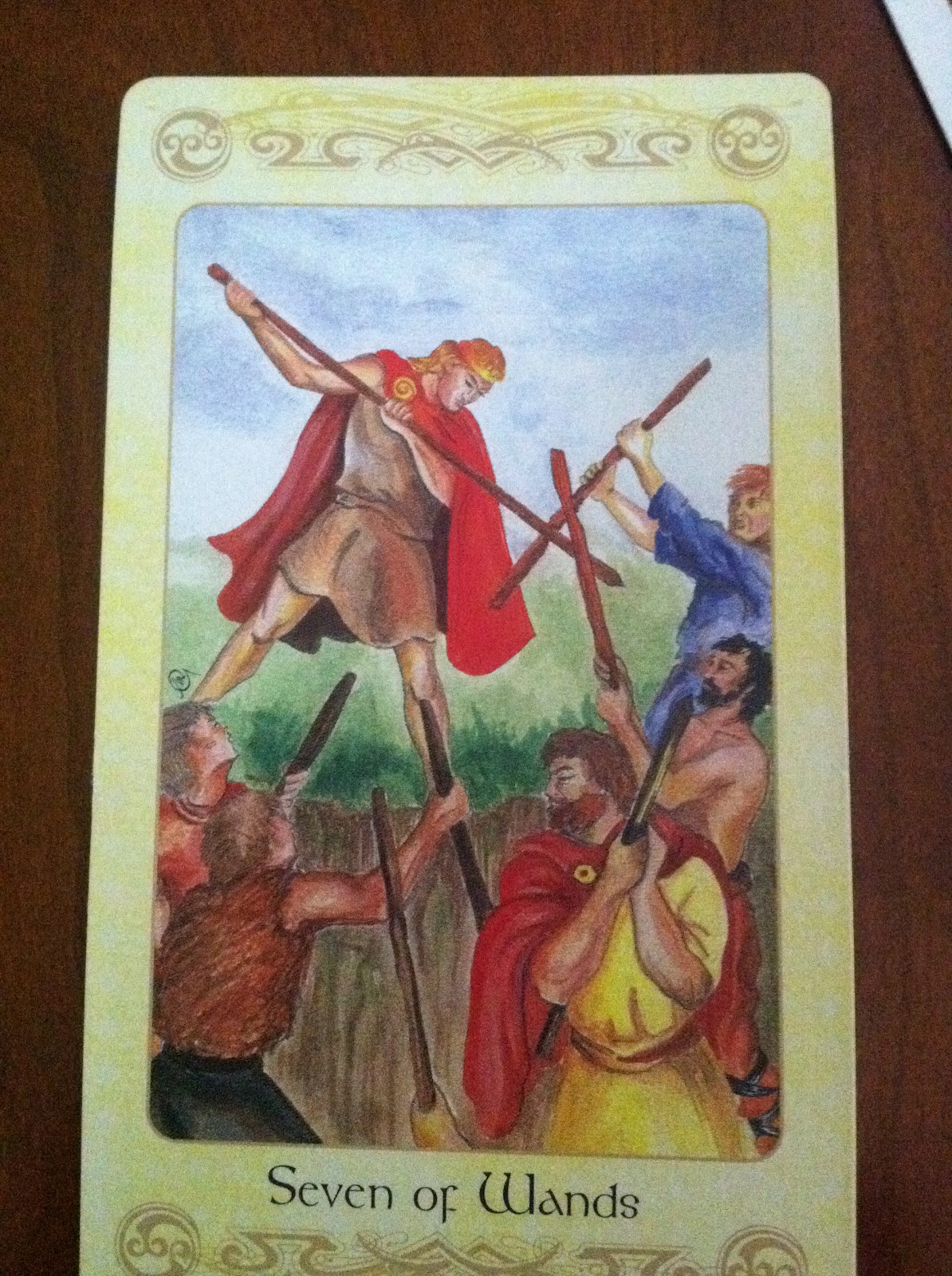
In the Celtic Deck, it is apparent that the protagonist on the hill is fighting against six other men. He still holds the high ground, and has a determined expression. Generally, if Seven of Wands shows up in a spread, it's telling you to stand your ground. You're probably going to come out on top, or at the very least learn what you're capable of.

Freyja, the mediator goddess between the warring gods of Aesir and the peaceful Vanir, is the goddess of the Staves. While the men on the Robin Wood and Celtic decks are confident, Freyja is uncertain. In certain situations, it is good to be wary. It could very well be that there are aspects of the situation that you are not aware of. Being wary will help you keep your position and maintain your supremacy.

Here is a man in a Damocles situation. What is unique about this card is that it reminds us that conflict may be caused by ourselves. We may take on to much and find ourselves overwhelmed. Such is the price tag with success, a concept associated with the Wands/Staves, as they are aligned with the external masculine energy.
Reversed, the Seven of Wands/Staves means that the questioner is overwhelmed and unstable. A retreat may be in order. It may also mean an argument will not be won, or a request will not be granted, as they are too many things working against it.
Moving along to the Coins/Pentacles:

The Seven of Pentacles/Coins is in keeping with the theme of rest and contemplation associated with the number. Here, a man is very content with his handiwork, which is growing and almost ready for harvest. From his gloves, it's apparent that it took hard work to get here, but it was worth it. This card signifies that now is a waiting period, and that good things are on the way, particularly if the question concerned financial, health, and real estate matters, which are under the umbrella of the earthy Pentacles.

The man here is contemplating his money. How much does he already have? How much more does he need? If he needs more, how can he get it? Those may be the questions the Seven of Pentacles may recommend the questioner consider.

In keeping with the garden theme--gardens as a metaphor for fertility, abundance, richness, patience, cycles, and hard work paying off--Lakshmi is depicted tending hers. The work is satisfying, and is not a hardship. She is full of happy anticipation. If the question is concerning whether work, education, or another venture will pay off, the Seven of Pentacles is a good omen.

Of course, Barbara G. Walker has to break up the happy-fun time and poop on everybody's party (I mean no disrespect. Barbara G. Walker is one of my heroes. It's just I know this change in tone is quite jarring and I wanted to add some levity). In her deck, Seven of Pentacles can mean failure. As far as I can see, this has to do with the nature of cycles, which is one of the concepts the Earthy Pentacles have to teach --sometimes the garden is fallow or frozen. However, in the distance is a dark door flanked by seven stars, leading into the cave. What is in that cave? Is there gold? Or perhaps a place to rest and recuperate from loss? Look at the other cards.
The Seven of Coins/Pentacles reversed in other decks say basically what Barbara G. Walker's upright Seven of Pentacles says, and also warns against impatience, laziness, and entitlement.
The Seven of Swords indicates a need to protect oneself, and vulnerability. It also indicates shadiness or deception, on the part of the questioner or on the part of someone the questioner knows.

The Seven of Swords tells the questioner to be careful--someone is either actively trying to harm them, or an impersonal crime may take place. Put up extra protection and be very watchful. Someone may be sneaking around or spreading rumors. This card can also indicate that the questioner may be up to no good, and are about to be caught, or get themselves entangled in the negative behavior. Those who live by the sword die by it.

This picture makes me think of Caesar's last moments. Watch your back, the cards are telling you. Someone may be a traitor.

Isis, the goddess of the Swords suit, is frightened as she carries her five swords. Her brother/brother-in-law Set (I know, right?) has killed her husband/brother, Osiris (I know, right?), not once, but twice, dismembering him the second time, and she must now put Osiris back together, all the while watching her back in case Set tries to kill her and Osiris again. The Seven of Swords is sympathetic. It knows how difficult it is to carry the burden of fear. It would make a world of difference if someone came to help carry the burden, but the Seven of Swords indicates isolation, or the feeling of isolation. When the Seven of Swords shows up, it may be beneficial to take stock of whom you can trust. You may not be as alone as you think.

Okay, I'm going to point out the elephant on the wall before anyone can jump to conclusions. Yes, that is a swatstika on the wall. Yes, when I saw it, I literally flinched. But trust me, Barbara G. Walker is NOT a Nazi. Here's the a brief history of this symbol, from her invaluable book, The Woman's Dictionary of Symbols and Sacred Objects: "Named for the Sanskrit 'so be it' or 'amen,' the swatstika has been a religious emblem of worldwide occurrence since at last 10,000 B.C. It appeared on the oldest coinage in India, on images of Buddha in Japan, and on Greek and Roman figures of the Great Goddess...It was still used as a magic sign in Europe up to the beginning of the twentieth century" (Walker 61). Even with such an illustrious history, the swatstika is another casualty of the Third Reich, and I won't touch it in my work with the runes (the Futhark and Futhorc do not even have the swatstika anyway).
Okay, now that that's out of the way, the woman, who is a wise crone, has created a circle of seven swords over her as a protective amulet. She sits with closed body language, with her arms and legs crossed. The black cat by her side is her familiar, an extension of her soul and boon companion. Again, this card seems to ask whom we can trust.
Reversed, a Seven of Swords indicates paranoia, or unrealistic fear,, and indicates that the questioner must seek help. It can also reveal truly dangerous activity or a terrible threat. Your intuition may also tell you, looking at the card, that a reversed Seven of Swords indicates the danger is past. Use the other cards surrounding it.
The Seven of Cups is a card of dreams and decisions.

Here, the girl's hair becomes the clouds. She is clearly in a flight of fancy. Her head isn't just in the clouds, it is the clouds! The young girl is constructing many lovely scenarios for herself--there's a cup of jewels with a dollar sign motif, a castle in a cup with a crown around the brim, and fireworks shooting out of the cup with the heart. What those stand for don't need explaining, but some of the symbols are more estoteric. The dragon in the red cup symbolizes power and passion. He's a little bedraggled, because he's been fighting temptation and oppression, as shown by the chains on the band of his cup. Dreams take work to come true, and sometimes a fight.
The snake in the cup with the moon waxing, full, and waning represents, wisdom and healing. Because snakes shed their skins, they were associated with healing and the shedding of disease. The molting of snakes was seen as a symbol of rebirth and renewal. The moons are symbolic of womanly wisdom, the feminine knowledge of the subconscious, the hidden, and nature cycles.
The laurel in the cup with the skull and crossbones motif is a visual pun meaning "Victory over Death" (Wood 201-208). The last one is a mask in a silver cup. The color of silver is symbolic of feminine energy and the moon. The mask is the Self. Getting behind the mask means the ultimate self-knowledge.
This is why I love Robin Wood. She is so rich in meaning and her artistry is stunning.

In the dreamy Celtic Deck, the Seven of Cups shows a woman peering off the back of a boat. Is she longing for the past, which will never come again? Is she happy with the person she is with, the person rowing the boat? Actually, he's not even rowing the boat. He's gazing at the beautiful sight before him, seven cups in a glowing pyramid. But is that vision real, or a mirage, an illusion? Is it distracting him from the real goal at hand, which is getting to shore? Is he not paying attention to his surroundings, and putting himself and his companion at risk?
Sometimes, the Seven of Cups warns us against illusions and distractions. It reminds us to know when to let go of a desire it is impossible to obtain, such as a return to the past, or the returning of a love who is not good for us.

In Kris Waldherr's goddess deck, Venus, the goddess chosen for the emotional, romantic cups, is dreaming of the snake, the castle, the crown, and the victory laurel. The skull can represent the ultimate knowledge of the afterlife, a rebirth, or holding death in the palm of your hand, or, in this case, a goblet. The rose is for sensual pleasure, beauty, and romance. Then there is a mysterious seventh cup, shrouded by a piece of white cloth. What is it? What surprises does the universe have in store?
There are many things to choose from. The Seven of Cups may indicate several choices, all of them equally appealing. The choice must be made, however, and the best way to think about it is with gratitude, and tell yourself that no bad decision can be made here.
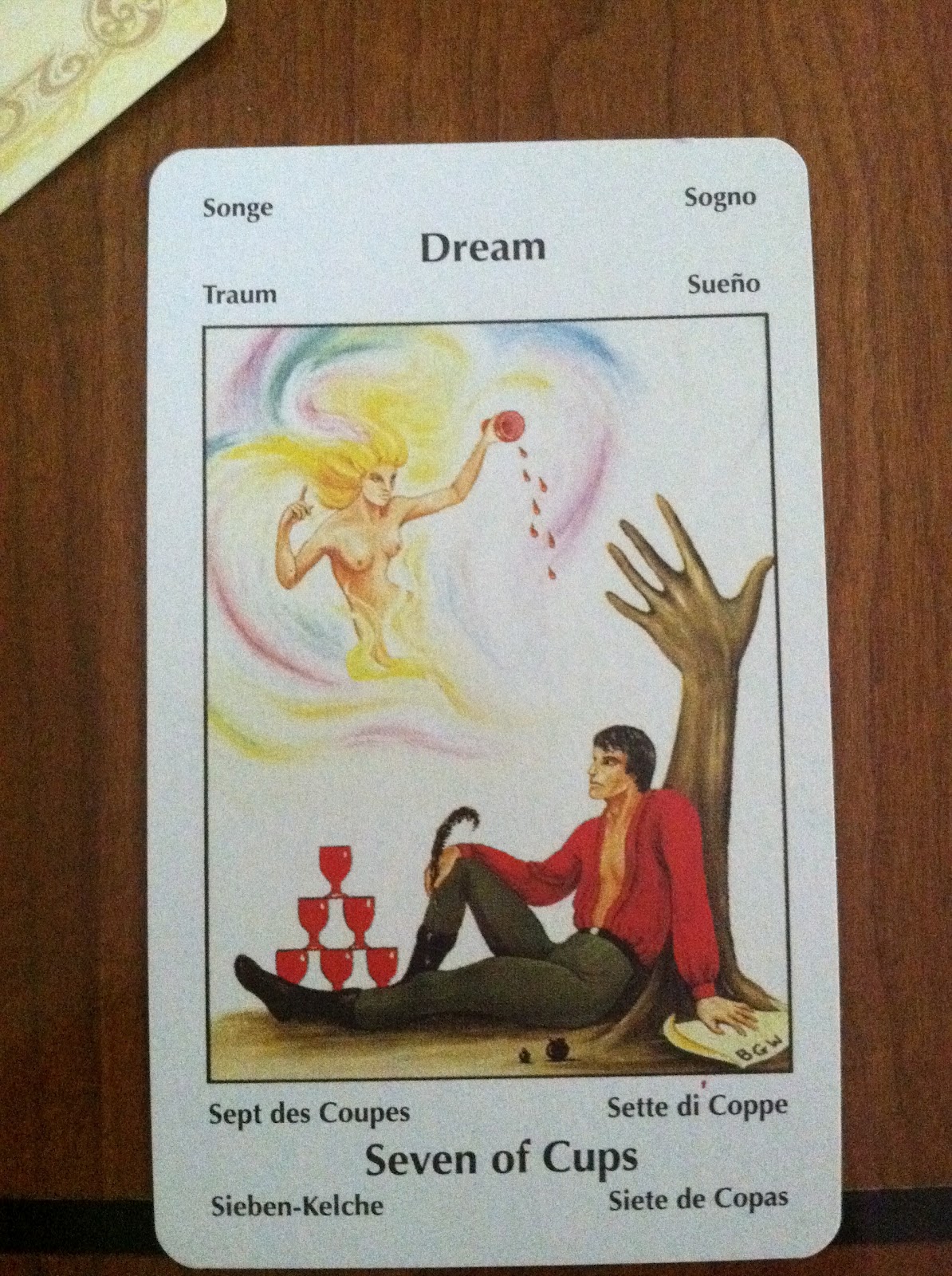
Here, a poet who makes me think of the Romantic poets (those transcendent, nature loving, emotional dreamboats!) or perhaps Rumi, the Sufi ecstatic. He has his quill and paper, and is gazing off into the soft swirling fires of inspiration, from which emerge a blonde angel (or siren, depending) with a rainbow aura. She sprinkles him with seven blood red drops from an overturned cup. She is the Muse, watering our imaginations. He leans on a tree shaped like a hand reaching to the heavens, symbolizing the desire to break earthly bounds. Seven of Cups may symbolize a visit from the Muse, but it may be ephemeral. Watch for insight and revelation, but also be careful of indulging false hopes or red herrings that may lead you away from what you may really want or need. For example, if you're seriously considering leaving a wonderful person for the person you're infatuated with simply because you're bored. Or, you're taking a job that you claim to love but you only love the money.
Reversed, Seven of Cups signals self-deception, false hopes, ennui, and indecision. It also may indicate spreading oneself so thin there's no commitment to any one thing.
Sources: Walker, Barbara G. The Woman's Dictionary of Symbols and Sacred Objects. San Francisco: HarperSanFrancisco, 1988. Print.
Wood, Robin. The Robin Wood Tarot: The Book. 1998. Livingtree, 2009. Print.
Saturday, June 9, 2012
The World
The World is the 21st and last card of the Major Arcana. It is a card of accomplishment, completion, success, and joy.

 |
| Barbara G. Walker |
Most cards for the World traditionally show a woman in the center of a wreath. The woman is Gaia, the archetypal Earth Mother. She is usually nude or draped in a robe to show a return to the natural state, the purity of the womb (which is associated with the Earth; think of Mother Earth and the Shamanic ritual of burial that ends with symbolic rebirth). The wands she holds indicate mastery, strength, and energy--she is a balance of male and female. The position of her legs form a backward four, a symbol of magical power.
Flanking her are a lion, a bull, an eagle, and a pixie-like creature. Traditionally, these stood for the four Gospel writers, Matthew, Mark, Luke and John, and also to the beasts referred to in Revelation. The pixie was a man. Now, they can still stand for those things, indicating community with God and a higher purpose. However, they can also stand for the four elements. The lion, the symbol for Leo, is fire; the bull is Taurus, earth; the man is Aquarius, air--which makes the pixie a sylph; and the Eagle is Scorpio, water. This again illustrates the balance the questioner has achieved; they are at home in all four elements and the qualities associated with each. Thus, the World card is a card of wisdom, mastery, and balance.
 |
| Robin Wood's World. |
Robin Wood's tarot deck shows the woman draped in a white sheet. It is white for purity, and she is draped in it to show she has achieved great honor. Her wreath is made of fresh flowers and fruit, for she is fruitful and accomplished and surrounded by beauty. Ribbons form the infinity symbol at the top and bottom. The four elements are represented in the four corners, again indicating balance and mastery of the qualities of those energies, and she's holding two wands in a blessing. Stars sparkle behind her in a blue sky--her thoughts are clear, she has foresight and knowledge, and she is a "star."
 |
| Kris Waldherr's Gaia |
Kris Waldherr's goddess for the World is, of course, Gaia, the ancient Greek personification of the Earth. The sun and the moon are in position above the Earth, showing, again, a balance of masculine and feminine energy. At the top of the card is a winter scene, and at the bottom a spring scene. This shows a knowledge of and respect for the Earth's cycles, which is apropos to The World being an end of the cycle of the Major Arcana, a cycle began by The Fool.
The two women supporting the Earth are symbolic, I believe, of both Western and Eastern philosophies, and the harmonious marriage of these ideas.

Julian De Burgh and Mary Guinan's Celtic deck is reminiscent of the stunning Book of Kells. It, like the others, shows the mastery of the four elements and their qualities. The Cup is Water, the Pentacle is Earth, the Sword is Air, and the Wand is Fire. The two figures in the center, if you look closely, are a man and a woman bound together in an intricate knot. Their legs are crossed, and the bottoms of their feet are touching, forming the shape of a heart. They are whole and fulfilled.
If The World shows up in a reading, it is very auspicious and joyous. It may indicate that the questioner's entire life is going well, or that at least one aspect of the person's life is booming--pay attention to the question and any other cards. Reversed, The World may portend postponement of this fulfillment, mastery, and joy. There may be more steps needed in the cycle before it reaches the completion of The World.
Wednesday, June 6, 2012
The Eights
In numerology, the number 8 is associated with power and success, completion and progress. It is a number that implies just rewards. As you may recall, Justice is the 8th card of the major arcana in some decks, and it is a card of karma and support from the universe. In other decks, the 8th card is Strength--a card of power, success, stamina, and courage.
In the minor arcana, the meaning of the number 8 depends on the suit. In the Suit of Wands, 8 is all about swift movement, whether literally, as in travel, or figuratively, toward reaching concrete goals or the realization of subconscious dreams.
Robin Wood's tarot deck shows Wands--the suit of energy and accomplishment--flying out of Earth's orbit and shooting past the moon. In the background is what appears to be the planet Jupiter, which is the planet of luck. Again, very auspicious if upright. If reversed, it means that there is some crashing and burning going on, or else there's not enough thrust to get off the ground.
In Kris Waldherr's deck, the Eight of Staves is framed by seething, roiling lava. This fiery energy could imply inexorable movement that melts or burns away any obstacles. In the background of the card is striking lightning. That's what the energy of this card can be like--it can be a tremendous bolt out of the blue, a stroke of good luck or inspiration. It can also indicate messages, whether positive (upright) or negative (reversed). Messages, opportunities, or ideas are things to watch out for when this card is received.
In the minor arcana, the meaning of the number 8 depends on the suit. In the Suit of Wands, 8 is all about swift movement, whether literally, as in travel, or figuratively, toward reaching concrete goals or the realization of subconscious dreams.
 |
| Celtic Eight of Wands, illus. by Mary Guinan
In Julian De Burgh's Celtic Deck, the Eight of Wands stampedes toward the viewer with a look of confidence, a wonderful sign for the questioner. If this card were reversed (upside down), however, the rider would be bucked off the horse, or crushed under it.
|
 |
| Robin Wood's Eight of Wands |
 |
| Kris Waldherr's Eight of Staves |
 | ||||||||||||
| Barbara G. Walker's Eight of Wands
Barbara G. Walker is sort of a throwback to the Middle Ages when everybody was dying left and right and you were lucky to get through the day without bringing out your dead or having your crops die of blight or getting whacked upside the head by a lord's cudgel. She does have a point, however. Sometimes, when things move too fast, or we push too hard, or have too much pride, we end up falling off our Pegasus (Pegasi?). Eight of Wands reversed, or upright in the Barbara G. Walker Deck, can indicate poor planning or excessive pride, like that of another famous wing-clad mythological figure, Icarus.
The keyword for Eights of Pentacles (or Coins) is learning.
Reversed Eights of Pentacles may represent an unwillingness to learn or work. It could also mean unrewarded or unacknowledged work.
Eight of Swords indicate entrapment, restriction, and oppression. However, the questioner should look closely at the cards.
Robin Wood's Eight of Swords shows a woman bound and blindfolded, marooned on a small strip of land, surrounded by eight swords. Again, the card shows a path. It is a narrow path. The questioner may have to grope his or her way out of this. There probably will be stumbles, and the questioner will feel helpless. However, the water on the sides may not be as deep or as rough as the questioner imagines. In fact, it rarely is. The path is there, and it is smooth. Go slowly and be gentle. Reversed, this could indicate very rough times ahead, in which case the other cards can be consulted for advice, or, it could mean that the rough times are ending. Use your intuition.

Kris Waldherr's deck shows Isis, the wife of Osiris, deep in despair as she tries to find her murdered husband's body so she can bring him back to life. If she stands, she can see that the swords are not unmaneuverable; she can tiptoe her way out of them. It may be, however, that she (and the questioner) may need to rest and have a good cry before she gets up and work their way out of the challenge that is bringing her such despair.
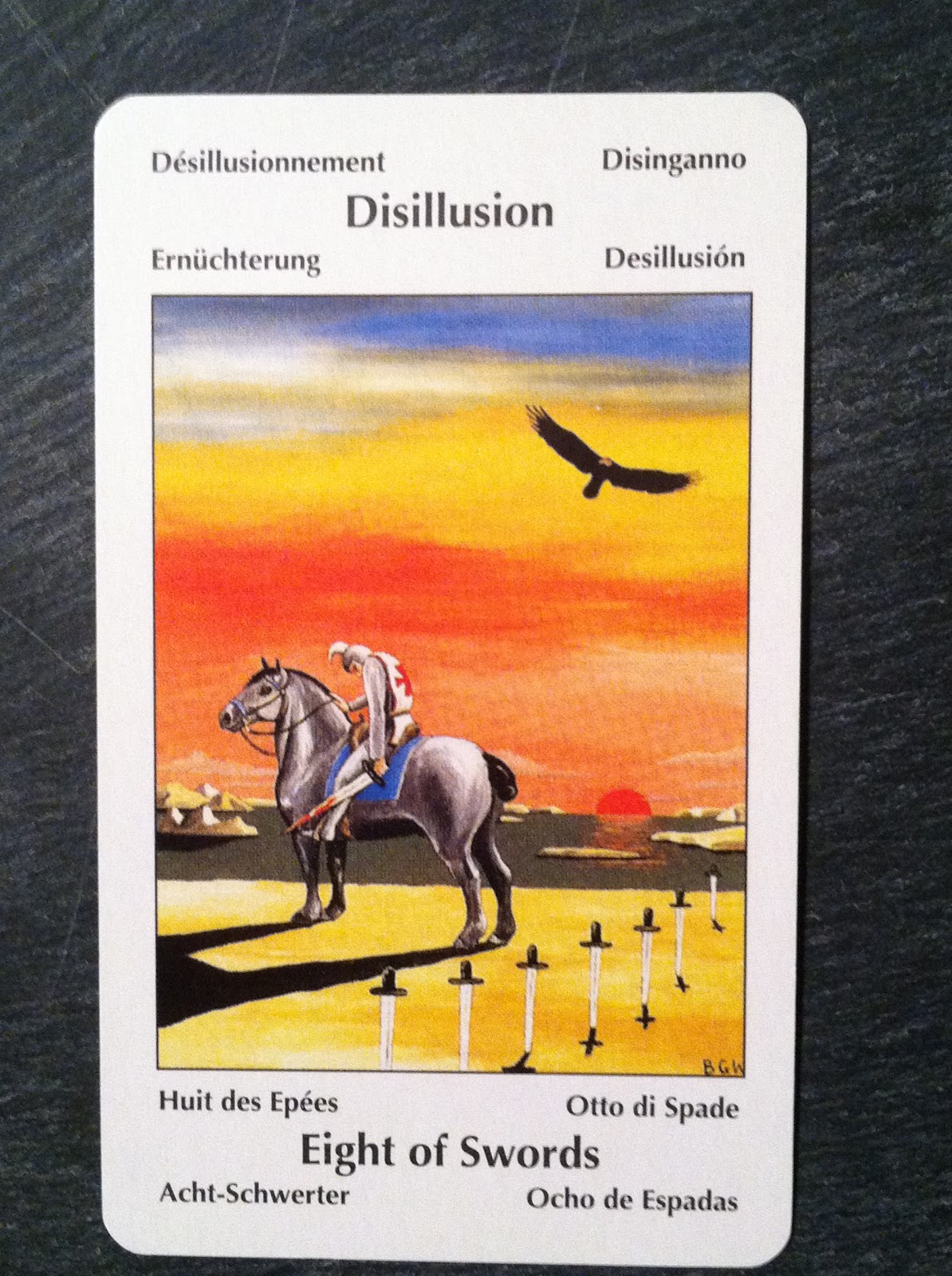
A battle-weary, weather- beaten crusader sits astride a gray horse, a symbol of death, on Barbara G. Walker's Eight of Swords. The shadows of the swords on the sand form the shapes of crosses, a symbol of death and loss (like grave stones). Is the crusader grieving his fallen comrades, or does he feel guilty? Look to your intuition, the other cards, and, if you are the questioner, your own feelings.
The key words for the Eight of Cups is disillusionment, disappointment, letting go, and moving on.

The girl on the Celtic Deck's Eight of Cups card tearfully flees a man in the background, running past eight cups artfully stacked. Her frustration and anguish is apparent.

Robin Wood's Eight of Cups shows a man leaving behind eight golden cups to venture out into the great unknown. The mountains, symbolic of enlightenment, are shrouded in mists of uncertainty, but he is not deterred. The Eight of Cups may indicate frustration and disappointment, but it may also show something wonderful coming to replace that which is outdated.

The goddess Kris Waldherr chose to represent the Suit of Cups is Venus, and she shows her looking back in indecision at eight cups. This leave taking may not be easy. There may be regret. But what is more regrettable--staying in an unfulfilling job/relationship/any life situation, or leaving for something better? The cups may be beautiful, but may be filled with something brackish. The Eight of Cups may be telling you to not stay in something that makes you unhappy for appearance's sake.

Barbara G. Walker's Eight of Cups shows what may be the only sad faun I have ever seen.

All Eight of his Cups are spilled into a pond. He leans against a dryad, or tree spirit. This is Pan, the Goat god, and Helice (the virgin form of Hecate, Greek goddess of magic, crossroads, the night, and necromancy) mourning the loss of their rites and their ways of life (Walker 22). Sometimes, the the Eight of Cups may indicate something taken from the questioner's life, not a voluntary leave taking, which is hard enough.
The Eights of Cups and the Eights of Swords may seem contrary to forward motion. It must be remembered that the oppression, fear, and despair brought on by loss is covers the changes that are happening deep in the questioner's life. These changes may be all but invisible, but as the clouds clear and light breaks through, there may be glorious surprises. I know. In the darkest time of my life, I once "woke up" (at around 8 p.m.) where I was and found incredible peace and joy. I don't know what it was, but I believe that something was working on me, slowing blowing a tiny, tiny flame to life inside my heart. Or maybe a seed was planted, and it was slowly taking root. Perhaps this has happened to you. I hope it has.
Source: Walker, Barbara G. Barbara Walker Tarot: Instructions. Stamford CT: US Game Systems Inc., 1986. Print.
|


Subscribe to:
Posts (Atom)